
Are you looking for a reliable source of Afghan pine nuts in Canada? RG Pinenuts connects international buyers with Afghan pine nut products, offering an opportunity for Canadian importers, wholesalers, distributors, specialty food retailers, restaurants, and food manufacturers to explore premium pine nuts from Afghanistan.
Afghan pine nuts, commonly known as Chilgoza, are valued for their distinctive flavor, culinary versatility, and association with the mountainous pine forests of the region. For Canadian businesses seeking differentiated ingredients, Afghan pine nuts can be considered for specialty retail, gourmet cooking, food manufacturing, and wholesale distribution.
Successful sourcing, however, involves more than choosing a country of origin. Buyers need to evaluate kernel quality, product identity, sorting, food safety, packaging, storage, traceability, shipping arrangements, and Canadian import requirements before committing to a commercial order.
RG Pinenuts was founded in Afghanistan in 2021 and specializes in supplying high-quality pine nut products. Our portfolio includes Golden Pine Nuts, Pine Nut Kernels, Pine Nut Oil, and Pine Nut Butter. We aim to build international business relationships around quality, hygiene, innovation, and trust.
Whether you are an established Canadian importer or a business exploring Afghan pine nuts for the first time, this guide explains how to assess suppliers, compare product formats, plan imports, and identify the information needed for a successful purchasing decision.
Looking for an Afghan pine nut supplier for Canada? Contact RG Pinenuts to discuss your product requirements, estimated quantity, packaging preferences, destination, and wholesale sourcing needs.
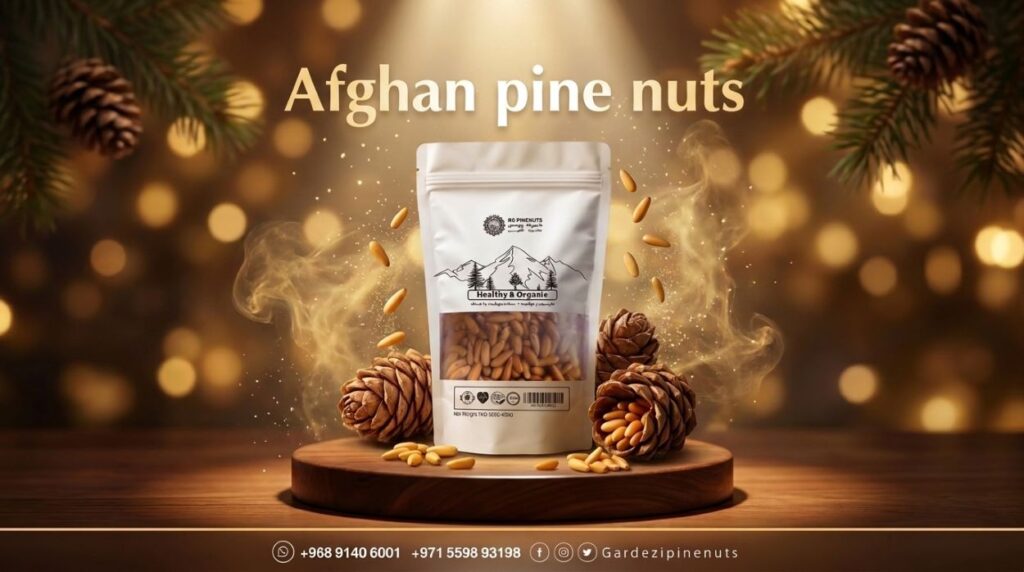
Canada offers opportunities for businesses selling specialty ingredients, nuts, gourmet foods, and international food products. Afghan pine nuts may provide a differentiated option for buyers looking to expand their product range beyond conventional nut varieties.
Their commercial suitability depends on the intended market, product quality, purchasing economics, and the supplier’s ability to meet the buyer’s specifications.
Afghan Chilgoza pine nuts are associated with Pinus gerardiana, a pine species found in parts of Afghanistan and neighboring regions.
Origin can help distinguish a specialty food product, particularly when a buyer wants to communicate the geographical background of its ingredients. For Canadian importers, this creates an opportunity to develop a product offering around authentic Afghan origin, provided the claim is accurate and supported by suitable documentation.
Businesses should distinguish between verified origin information and general marketing descriptions. Botanical identity, harvest location, processing location, and country of origin are related but not interchangeable concepts.
A supplier should be able to explain the origin information available for its products and clarify what documentation can support commercial claims.
Afghan pine nuts may be relevant to several types of Canadian businesses:
Each buyer category has different requirements. A distributor may prioritize consistent supply and packaging efficiency, while a restaurant may focus on flavor, convenience, and dependable replenishment.
A food manufacturer may need a detailed product specification, laboratory results, and evidence that the ingredient performs consistently in its formulation.
The first step is to identify the target customer and select a product format that meets its needs.
Retailers can consider Afghan pine nuts as part of a premium nut assortment, a specialty ingredient range, or a collection of internationally sourced foods.
Differentiation should be based on verifiable characteristics, such as product identity, origin, quality, flavor, and packaging. Avoid unsupported claims about being the largest, healthiest, most nutritious, or best-quality product.
A clear product description and accurate origin information can help customers understand what makes the product distinctive.
Pine nuts are used in a range of culinary applications, including salads, pesto-style sauces, rice dishes, baked products, desserts, and specialty recipes.
Their mild, nutty flavor can complement both savory and sweet preparations. In commercial kitchens, they may be used as a garnish, an ingredient in sauces, or a component of a signature dish.
For manufacturers, suitability depends on the kernel’s size, appearance, flavor, moisture, and stability during processing and storage.
Canadian businesses purchasing specialty nuts often need more than a one-time transaction. They need suppliers who can communicate clearly, provide suitable documentation, and work toward consistent product specifications.
Before establishing a long-term relationship, buyers should evaluate sample quality, product specifications, commercial terms, delivery planning, and the supplier’s approach to quality concerns.
RG Pinenuts welcomes inquiries from businesses interested in Afghan pine nut products. Specific product availability, order quantities, packaging, and export arrangements should be confirmed directly.
Chilgoza is the common name used for pine nuts associated with Pinus gerardiana. These nuts are valued as a food ingredient and have an established culinary role in parts of South and Central Asia.
For international trade, it is important to identify the product accurately. Pine nuts from different Pinus species may differ in appearance, composition, flavor, and processing characteristics.
Pine nuts can be traded in different formats, depending on availability and the buyer’s intended use.
Whole or in-shell pine nuts retain the shell. This format may suit particular markets or applications, but buyers should assess shell condition, handling requirements, and the amount of usable kernel obtained.
Shelled pine nut kernels are ready for applications that require the edible kernel. Buyers may evaluate color, size, uniformity, broken pieces, foreign matter, flavor, and other relevant quality attributes.
The most appropriate format depends on the buyer’s processing capabilities, customer preferences, and cost calculations.
The term “pine nut” covers products from several pine species. Composition data for one species should not automatically be treated as a specification for another.
Research on pine nuts has examined differences in fatty-acid composition, chemical characteristics, and other quality indicators. For Canadian buyers, this reinforces the importance of requesting information that relates to the actual product being purchased.
If botanical identity is important to your brand or specification, discuss the available supporting evidence with the supplier before placing an order.
RG Pinenuts was founded in 2021 in Afghanistan and specializes in supplying high-quality pine nut products for business customers.
Our product portfolio includes:
Our brand message is:
RG Pinenuts — Pure Quality. Trusted Origin.
For Canadian buyers, the most useful starting point is a direct discussion about the required product, volume, packaging, and intended application.
Product-specific information should be confirmed before an order is finalized. This includes available formats, grade, specifications, processing details, laboratory documentation, and shipment arrangements.
We encourage importers and distributors to explain their requirements clearly so the appropriate product and commercial options can be evaluated.
Quality assessment is essential when buying pine nuts for wholesale, retail, food service, or manufacturing.
A product can look attractive but still require closer evaluation for flavor, storage history, food safety, and consistency. Buyers should establish written acceptance criteria rather than rely solely on visual inspection.
Pine nut kernels should be evaluated for appearance, color consistency, and the presence of visible defects.
Unusual discoloration, damaged kernels, or excessive variation may justify further inspection. However, appearance alone cannot establish food safety or guarantee that a product meets its specification.
The acceptable appearance should be defined for the particular grade and intended application.
Flavor and aroma are important for consumer acceptance. Pine nuts may be used in products where their mild, nutty character is a key part of the finished recipe.
Unusual, stale, or rancid odors may indicate deterioration or unsuitable handling. Sensory inspection should be performed using an appropriate procedure and should complement other quality checks.
Buyers should consider the presence of shell fragments, stones, dust, damaged kernels, or other foreign material.
Cleaning and sorting can reduce unwanted material, but the result should be assessed against a written specification. If the pine nuts will be used in a manufacturing process, the buyer may need additional requirements for particle size, uniformity, or foreign-material control.
Moisture management is important for maintaining product quality during storage. The appropriate specification depends on the product, packaging, storage environment, and intended shelf life.
Buyers should request relevant information about moisture testing and storage practices. They should also clarify the conditions required after the product arrives in Canada.
Pine nuts contain fats that can deteriorate over time. Oxidation may affect flavor, aroma, and other quality characteristics.
The risk depends on the raw material, storage history, exposure to oxygen, light, temperature, and packaging. A reliable assessment should combine appropriate sensory checks with relevant analytical methods where required.
Food-safety risks cannot be ruled out by visual inspection alone. Depending on the product and risk assessment, buyers may require testing or documentation related to microbiological hazards, pesticide residues, heavy metals, or other contaminants.
The correct testing program depends on the source, processing conditions, product type, and destination-market requirements.
Canadian importers should confirm the applicable rules for the actual commodity and shipment rather than assume that a generic certificate is sufficient.
For repeat orders, buyers should compare new shipments against an agreed specification.
Batch identification, relevant test results, and documented acceptance criteria can help businesses investigate variations and manage incoming-goods checks.
Practical buyer tip: Before purchasing a large volume, request a sample and the available product specification. Agree on the quality criteria in writing and confirm which documents will accompany the commercial shipment.
Processing practices influence the physical quality and suitability of pine nuts for different markets.
The actual production process varies by supplier, raw material, equipment, and product format. Buyers should ask the exporter to describe the steps used for the specific product rather than assume that all suppliers use the same methods.
Quality management begins with the condition of the incoming pine nuts.
Raw-material inspection can help identify visible defects, unsuitable material, or problems requiring further evaluation. Storage before processing is also important because deterioration may occur before the nuts reach the final production stage.
Cleaning is intended to remove unwanted material from the raw product. Depending on the process, this may involve suitable mechanical equipment and inspection procedures.
The effectiveness of cleaning should be evaluated against the buyer’s specification.
For shelled kernels, the shell must be separated from the edible portion. The process should be designed to minimize kernel damage while achieving the required product format.
Broken-kernel tolerances may differ between food manufacturers, retailers, and other buyers.
Sorting can help separate kernels according to selected characteristics, such as size, appearance, or defects.
Optical sorting and imaging technologies are used in parts of the food-processing industry to support inspection and product separation. Their suitability depends on the material, equipment, operating conditions, and the characteristics being assessed.
These technologies should be described as part of a supplier’s capabilities only when they are actually used.
The final stage should confirm that the product meets the agreed specification before packaging and shipment.
Relevant checks may include appearance, foreign matter, package condition, batch identification, and required documentation.
For Canadian buyers, a well-defined process can make incoming inspection more straightforward and reduce uncertainty when evaluating a new supplier.
Research into nut quality and food processing continues to explore ways to improve detection, storage, traceability, and packaging.
These developments provide useful context for buyers, but laboratory findings do not automatically mean a technology is commercially available or used by a particular exporter.
Machine-vision systems can analyze product images to identify selected visual characteristics. In food processing, these systems may support the detection of defects or the separation of products according to defined criteria.
The practical value depends on the quality of the imaging system, the training or calibration method, and the ability to detect the relevant defect consistently.
Buyers should ask suppliers what inspection methods they actually use and how they verify the resulting product quality.
Researchers have investigated non-destructive approaches for evaluating agricultural products without cutting or destroying every sample.
Depending on the method and application, these approaches may help identify internal or external characteristics that are difficult to assess through simple visual inspection.
However, results from a research study should not be treated as proof that every commercial batch can be screened for every defect. Method validation and suitable sampling remain important.
Digital records can help connect a product to its batch, processing stage, inspection information, and shipment documents.
Where implemented, traceability systems can improve document retrieval and help businesses respond more efficiently to quality concerns.
The usefulness of a traceability system depends on accurate data entry, clear batch identification, and the completeness of the records.
Packaging research explores ways to reduce exposure to oxygen, moisture, light, and other factors that can affect food quality.
Potential approaches include improved barrier materials, protective packaging systems, and better monitoring of storage conditions.
Not every innovation is appropriate for every product or cost level. Buyers should focus on packaging performance, food-contact compliance, transport durability, and evidence supporting the intended shelf life.
Digital records and analytical tools can help businesses compare batches, identify recurring quality issues, and monitor supply-chain performance.
For importers, these tools are most useful when they lead to practical improvements: clearer specifications, faster document checks, more consistent incoming inspections, and better communication with suppliers.
The most important innovation is not a technology label. It is a demonstrable improvement in quality, safety, consistency, traceability, or logistics.
Ask suppliers for evidence of the controls that matter to your product and purchasing decision. Avoid assuming that an exporter uses advanced optical sorting, automated testing, or digital traceability unless those capabilities are confirmed.
Packaging should protect the product throughout storage and transportation while meeting the buyer’s requirements and applicable Canadian rules.
The appropriate packaging format depends on whether the product is sold at retail, distributed in bulk, or used as an ingredient in food manufacturing.
Wholesale buyers may prefer packaging designed for efficient handling, warehousing, and distribution.
Important considerations include:
The actual packaging options and quantities should be confirmed with the supplier.
Retail-ready packaging may need to accommodate branding, product information, net quantity, lot identification, date marking, storage instructions, and other applicable labeling elements.
The design should be reviewed for the Canadian market before printing. Requirements can differ based on the food, claims, package format, and the way the product is sold.
Some Canadian businesses may wish to sell Afghan pine nuts under their own brand.
A private-label arrangement can involve product specifications, artwork, packaging selection, label review, minimum order quantities, and production planning.
Availability depends on supplier capabilities and the commercial arrangement. Buyers should confirm these details before committing to a private-label launch.
Packaging can help protect pine nuts from moisture, contamination, physical damage, and deterioration, but no package eliminates all quality risks.
The product’s condition also depends on handling, storage, and distribution. Buyers should ask about recommended storage conditions and shelf-life evidence for the actual product.
Importing food into Canada involves regulatory, documentation, and commercial considerations. The specific requirements depend on the product’s identity, processing, packaging, intended use, and other relevant factors.
The Canadian Food Inspection Agency states that most imported food is subject to requirements under the Safe Food for Canadians Regulations, including applicable licensing, preventive controls, and traceability obligations. Importers should confirm their responsibilities before arranging a shipment.
Before importing, check the CFIA’s Automated Import Reference System (AIRS) for the exact commodity and import circumstances.
AIRS is updated regularly, so importers should verify the requirements close to the time of import rather than rely solely on old advice or a previous shipment. The CFIA also explains that certain foods can have additional requirements beyond the general import rules.
Most food importers need an appropriate licence under the applicable Canadian rules, subject to the relevant exceptions.
The Canadian importer should confirm its licensing status and responsibilities before the goods are shipped. A supplier’s export documentation does not replace the importer’s obligations under Canadian law.
Imported food must meet applicable Canadian requirements. The rules address how food is manufactured, prepared, stored, packaged, and labelled, as well as relevant preventive controls.
Importers should establish suitable supplier-verification and food-safety procedures for the product and business. The details should reflect the actual risk and applicable regulatory obligations.
Traceability information can help identify the source of a product and track it through the supply chain.
Buyers should confirm how the shipment will be identified and which records will be available, including relevant product and batch information. The importer should maintain the records required under the applicable Canadian rules.
Retail food labels must meet applicable Canadian requirements. Depending on the product and how it is sold, these may include the common name, net quantity, ingredient information, business identification, lot or date information, storage instructions, and other required details.
Some foods and claims trigger additional requirements. The label should be reviewed for the actual product and sales format before packaging is printed or imported.
Do not assume that a label prepared for another country will automatically satisfy Canadian requirements.
If a product is marketed as organic in Canada, the applicable Canadian organic requirements and certification documentation must be reviewed.
A supplier should not use the term “organic” as a substitute for documented compliance. Buyers should verify the status of the specific product and any required certification before relying on an organic claim. The CFIA provides guidance on organic food imports and the relevant requirements.
Importers should establish the correct tariff classification for the exact product and confirm the applicable tariff treatment with the Canada Border Services Agency or a qualified customs professional.
Classification and duty treatment can differ by product form and other factors. Do not assume that the tariff treatment for in-shell pine nuts is necessarily identical to that for every processed pine nut product.
A current tariff review should form part of the landed-cost calculation before an order is finalized.
Commercial planning should cover shipment timing, packaging condition, transport arrangements, customs clearance, receiving procedures, and storage after arrival.
Buyers should agree on the commercial terms and division of responsibilities with the supplier and logistics provider. The importer should also have a plan for checking the shipment against the purchase specification when it arrives.
Important: This section is a general commercial overview, not a substitute for product-specific regulatory advice. Canadian importers should verify the current rules for their exact product and shipment.
The lowest quoted product price does not always represent the lowest total purchasing cost.
For Canadian importers, landed cost is a useful way to compare suppliers after accounting for the relevant expenses associated with getting the product to its destination.
Depending on the transaction, the calculation may include:
Not every cost applies to every shipment. The buyer should identify which charges are included in the supplier’s quotation and which will be paid separately.
A fair comparison requires equivalent products.
For example, a quotation for shelled kernels should not be compared directly with one for in-shell pine nuts without considering processing, usable yield, and handling requirements.
Likewise, buyers should compare packaging, grade, testing, delivery terms, and order size—not just the price per kilogram.
A low price can become expensive if the product fails to meet the agreed specification, has poor shelf life, or arrives with inadequate documentation.
The commercial decision should balance cost, quality, compliance, delivery reliability, and suitability for the intended customer.
Supplier evaluation should be systematic, particularly for first-time imports.
Ask for a clear product description and the origin information available for the product.
If the buyer requires a specific botanical identity or origin claim, request appropriate supporting evidence.
A product specification provides a basis for comparing offers and setting acceptance criteria.
A sample can help evaluate appearance, aroma, flavor, and suitability for the intended use. For larger orders, buyers should clarify how sample approval relates to the commercial batch.
Depending on the product and risk assessment, buyers may request laboratory results or certificates of analysis covering relevant quality and safety parameters.
The test panel should be appropriate to the actual product and intended use. A generic certificate should not be assumed to address every buyer or regulatory requirement.
Understand the packaging format, storage instructions, and shelf-life information available.
For repeat orders, consider how the supplier manages batch identification and communicates any changes to product specifications or packaging.
Confirm the order quantity, payment arrangements, production lead time, shipment terms, and process for addressing quality disputes.
The quotation should clearly identify what is included and what remains the buyer’s responsibility.
A suitable supplier should be able to explain its product and commercial terms clearly.
Buyers should distinguish between confirmed capabilities and services that may be possible only after further discussion.
Canadian distributors need products that fit their customer base, storage capacity, packaging requirements, and purchasing model.
Afghan pine nuts may be considered for a specialty nut range, gourmet food distribution, ingredient supply, or selected retail channels.
Importers should focus on product specifications, documentation, landed cost, regulatory requirements, and the supplier’s ability to meet the agreed terms.
A written purchasing specification can help align expectations before the goods leave the exporting country.
Retailers should consider packaging, shelf presentation, product information, customer demand, and storage requirements.
Claims about origin, organic status, nutrition, or other product attributes should be supported and compliant with applicable rules.
Restaurants may value flavor, consistency, ease of use, and dependable replenishment.
The best product format depends on menu applications and purchasing volumes. Food-service buyers should evaluate samples in the recipes for which the pine nuts are intended.
Manufacturers may require defined specifications, batch records, ingredient documentation, and additional testing relevant to their process.
Before adopting a new ingredient, they should assess how it performs in the final product and confirm any relevant labeling or allergen considerations.
Private-label businesses should plan product identity, packaging, artwork, compliance review, and order quantities together.
Label claims must be supported by evidence, and packaging should be finalized only after the applicable requirements have been reviewed.
Sustainability is an important topic in specialty food sourcing, but it should be addressed through evidence rather than broad claims.
For pine nuts, relevant considerations may include harvesting practices, raw-material traceability, efficient processing, product waste, packaging choices, and transport.
The environmental impact of a product depends on the entire supply chain. A claim such as “sustainably sourced” should be supported by information about the actual practices and any relevant verification.
Traceability helps buyers understand where a product came from and how it moved through the supply chain.
The available information may vary by supplier and product. Canadian importers should determine which records are required by regulation and which additional records are needed for their own quality or customer commitments.
Good handling, appropriate storage, and suitable packaging can help reduce losses caused by physical damage or deterioration.
Buyers can also consider how packaging size and inventory planning affect waste in their own distribution systems.
Sustainability claims should be proportionate to the evidence available and should not imply certification or environmental performance that has not been demonstrated.
Avoiding preventable mistakes can make international sourcing more predictable.
Mistake 1: Choosing only by price. Compare product specifications, documentation, packaging, delivery terms, and landed cost alongside the quoted price.
Mistake 2: Skipping product evaluation. Where feasible, review a sample and agree on acceptance criteria before a larger order.
Mistake 3: Assuming all pine nuts are the same. Confirm the product identity, format, and relevant specifications.
Mistake 4: Treating general research as a product guarantee. Published findings about pine nuts do not automatically establish the quality, composition, or safety of a specific commercial batch.
Mistake 5: Ignoring Canadian import requirements. Verify product-specific rules, licensing, documentation, and labelling before shipment.
Mistake 6: Using unverified marketing claims. Origin, organic status, certification, quality, and sustainability claims should be supported by appropriate evidence.
Mistake 7: Leaving packaging decisions until the last minute. Agree on packaging, labeling, storage, and transport requirements before production and shipment.
Mistake 8: Failing to define the purchasing process. Confirm quantities, payment terms, delivery responsibilities, and how quality concerns will be handled.
Canadian buyers can explore Afghan pine nuts through importers, distributors, and international suppliers. Product availability varies, so businesses should confirm the product format, quantity, delivery options, and applicable import requirements.
Chilgoza is a common name associated with pine nuts from Pinus gerardiana. These nuts are associated with parts of Afghanistan and neighboring regions. Buyers should confirm the botanical identity and origin of a specific commercial product.
RG Pinenuts welcomes international business inquiries about Afghan pine nut products. Canadian buyers should contact the company to confirm current product availability, order quantities, packaging, shipping arrangements, and documentation for their intended purchase.
RG Pinenuts’ portfolio includes Golden Pine Nuts, Pine Nut Kernels, Pine Nut Oil, and Pine Nut Butter. The availability and suitability of each product for a Canadian order should be confirmed directly.
Wholesale sourcing may be suitable for importers, distributors, retailers, restaurants, and food manufacturers. Buyers should provide their expected volume, product format, destination, and packaging requirements when requesting a quotation.
Verify the applicable CFIA requirements, importer licensing obligations, product-specific rules in AIRS, food-safety documentation, traceability, labeling, and customs classification. Requirements depend on the exact product and shipment.
Most food importers require an appropriate licence under the Safe Food for Canadians Regulations, subject to applicable exceptions. Importers should confirm their specific obligations with the CFIA before arranging the shipment.
Depending on the product and transaction, buyers may request a product specification, relevant laboratory results, batch identification, origin information, commercial invoice, packing list, and applicable export or food-safety documentation. The precise requirements should be confirmed for the destination and shipment.
Review appearance, flavor, aroma, physical defects, storage information, and relevant analytical results. The required quality checks depend on the product and intended use.
They may be suitable for selected culinary and manufacturing applications. Buyers should test the product in their intended recipes or processes and confirm that it meets the necessary specification and food-safety requirements.
Organic claims must meet the applicable Canadian requirements. Buyers should verify the product’s certification and documentation before marketing it as organic in Canada.
Contact RG Pinenuts with your product requirements, estimated quantity, destination in Canada, preferred packaging, and any quality or documentation requirements. These details help establish which supply options can be discussed.
Choosing an Afghan pine nut supplier for Canada requires careful evaluation of product identity, quality, packaging, traceability, import compliance, and commercial terms.
For importers, wholesalers, distributors, retailers, restaurants, and food manufacturers, a clear purchasing specification is the foundation of a productive supplier relationship.
RG Pinenuts welcomes inquiries from Canadian businesses interested in Afghan pine nuts and related products. Share your requirements so that product availability, specifications, packaging, and potential export arrangements can be discussed.
Contact RG Pinenuts today to discuss Afghan pine nuts for Canada and request a wholesale quotation.