
Last updated October 2026
Organic pine nut oil is oil pressed from pine nuts that were grown or gathered under certified organic rules and processed without synthetic solvents, with every step documented and checked by a third-party certifier. That is what the label promises, and it’s worth knowing exactly where the promise ends. Organic does not mean the oil is cold-pressed, fresh, lab-tested for heavy metals, or proven to be healthier than a conventional bottle.
Because pine nut oil is expensive and almost impossible to verify by taste, the organic claim carries a lot of weight in the buying decision, and it attracts shortcuts. This guide explains what organic actually requires for a nut that mostly grows wild in forests, how certification works in the US, Canada, and the UAE, what organic does and doesn’t change about the oil, and how to check that a bottle is genuine before you pay a premium for it. If you want the full picture on the oil itself, including pinolenic acid, the research, and kitchen uses, see our [link: complete guide to pine nut oil]. This article stays on the organic question.
The short version
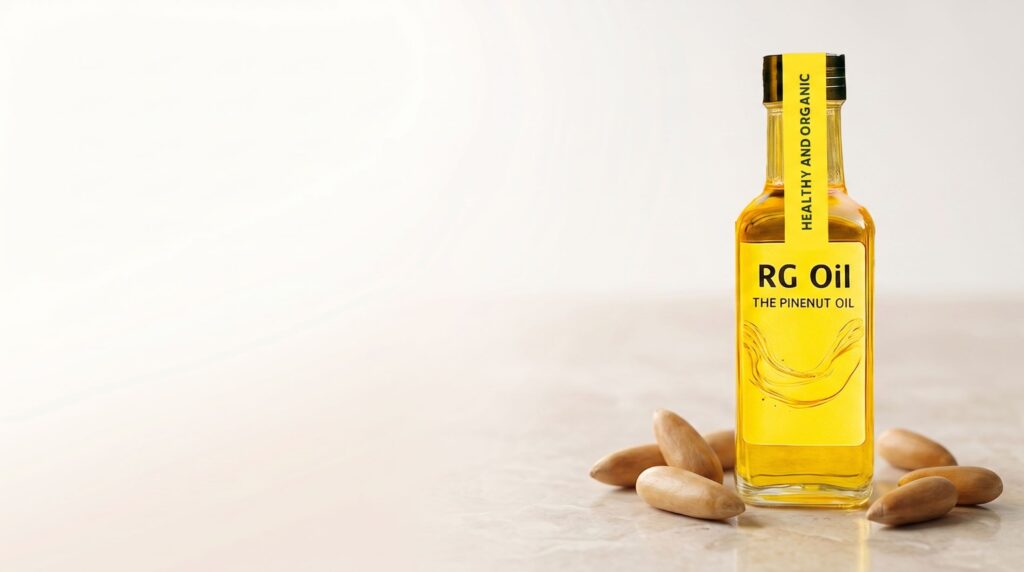
Organic is a claim about process, not about the finished product. A certified organic oil is one where the growing or gathering, the handling, the pressing, and the packaging all happened under a documented system that an accredited third party inspects. The oil itself is not tested to see whether it is organic. The paper trail and the site inspections are the proof, which is why the paper trail matters so much.
For pine nut oil, that raises a question most organic guides skip: where do pine nuts come from? Pine trees are slow to reach bearing age and many commercial species grow in forests rather than in planted orchards, so a significant share of the world’s pine nuts are gathered from forest stands. Organic rules have a category for this, called wild-crop harvesting.
Under the USDA National Organic Program, a wild crop can be sold as organic only if it comes from a designated area where no prohibited substances have been applied for the three years before harvest, and only if it is harvested in a way that is not destructive to the environment and sustains the growth and production of the wild crop. The operation submits an organic system plan that lays out the collection area, who harvests, and how the natural resources are monitored and maintained, and the harvest is verified at inspection.
USDA guidance spells out some limits that are easy to miss. Uninformed, unmanaged gathering that doesn’t maintain or improve the natural resources can disqualify a wild crop. And picking nuts from an abandoned orchard doesn’t count as wild-crop harvesting either, because no documented management is taking place. In other words, “we collect from the forest” is not the same sentence as “we are certified organic.”
Pine nuts reach the market through two broad routes, and they are certified differently.
Wild-crop harvesting. Nuts are gathered from natural forest stands. Certification depends on a mapped collection area, records showing nothing prohibited has been applied there, trained collectors, and chain-of-custody documents that follow the nuts from many individual gatherers to the press. Because so many hands are involved, this is where certifiers look hardest at the paperwork.
Managed or cultivated stands. Where trees are planted or actively managed, the operation is certified as a crop, with documented practices for things like pest management and soil health.
It helps to be honest about what organic certification adds in each case. Many wild pine forests have never been sprayed with anything, so for those nuts the value of the certificate is less “they stopped using pesticides” and more “someone verified the area, the harvest, and the handling, and kept organic nuts separate from conventional ones.” That is real value, especially in a product where mixing and mislabeling are tempting, but it’s a different kind of value from the farm-field story most people picture when they see the word organic.
One more point: the organic label says nothing about which pine species the nuts came from. A certified organic oil can be pressed from any edible pine seed, so the species on the label (for example Pinus koraiensis or Pinus sibirica, the types most studied for pinolenic acid) is a separate thing to check.
Certification does not stop at the forest edge. Organic handling rules require that organic nuts and oil are kept separate from conventional ones, restrict the processing aids that can be used, and rule out irradiation.
The rule that matters most for oils is the solvent rule. Hexane, a petroleum-derived solvent widely used in industrial oilseed extraction, is not allowed in certified organic oils. Pine nut oil is normally pressed rather than solvent-extracted, especially at the premium end, but the organic standard turns that from a marketing claim into an enforceable requirement. If you’re comparing a very cheap pine nut oil blend or capsule with an organic one, the extraction method is one of the places where they may genuinely differ.
What the organic standard does not set is just as important. It doesn’t say how hot the press ran, how long the nuts were stored before pressing, or when the oil was bottled. An organic oil can be pressed warm, stored badly, and sold stale. This is why the common label terms mean different things:
| Label term | What it tells you | What it doesn’t tell you |
|---|---|---|
| Certified organic | A certified supply chain; no prohibited synthetic inputs on the crop or collection area; no synthetic solvents | Pressing temperature, freshness, species, contaminant levels |
| Cold-pressed | Mechanical pressing at a low temperature, without solvents | Whether the nuts were organic; “cold” is defined differently by different producers |
| Wild-harvested or wild-crafted | Nuts gathered from forests rather than farmed | Whether the area, harvest, or handling was certified |
| Natural | Almost nothing | Almost everything |
| Non-GMO | No genetically modified ingredients | Anything about pesticides or solvents (and pine nuts are not a genetically modified crop in the first place) |
| Pesticide-free | A claim by the seller | Whether anyone verified it |
The fair answer is: probably not in the way marketing implies, though there are sensible reasons to prefer it.
Nutrition. A widely cited 2012 review in the Annals of Internal Medicine found no strong evidence that organic foods are significantly more nutritious than conventional ones. Nothing suggests pine nut oil would be an exception, and the fatty acid profile is driven mostly by species and processing, not by organic status.
Residues. Here the argument is stronger. Oils are fat, and fat-soluble residues, if present on the raw material, tend to end up in the oil rather than being washed away. Organic production restricts synthetic pesticides, and the same review found organic produce was less likely to carry detectable pesticide residues. That reasoning plausibly applies to pine nut oil too, but we haven’t seen testing that shows it for pine nut oil specifically, and as noted above, many wild pine forests are unsprayed to begin with.
The research on pinolenic acid. The studies that make pine nut oil interesting, on appetite hormones, lipids, and inflammation, did not compare organic and conventional oil. We haven’t found any trial that does. So there is no evidence that the benefits discussed in the research apply more strongly to an organic bottle. For what the research does and doesn’t show, see our [link: complete guide to pine nut oil].
So why choose organic? Reasonable reasons include lower exposure to synthetic farm inputs, assurance that no hexane touched the oil, a documented and inspected supply chain, and a preference for the way organic standards treat land and harvest sustainability. Those are good reasons. “It’s a health upgrade” is not one the evidence supports.
Organic is regulated nationally, not globally, so the seal you look for depends on where you’re buying.
In the US, organic claims fall under the USDA National Organic Program, and certification is carried out by USDA-accredited certifying agents. Labels use specific tiers: “100 percent organic” for products made entirely from organic ingredients, and “organic” for products that are at least 95 percent organic. A single-ingredient oil should land in one of those two tiers; a vague phrase like “made with organic ingredients” on a bottle of pure oil is a reason to look closer. The USDA organic seal may appear on qualifying products, and the label must name the certifier.
The useful part for shoppers is that US certificates are searchable. USDA’s Organic Integrity Database lets you look up a certified operation and see what it is certified to handle. USDA’s Strengthening Organic Enforcement rule, in effect since 2024, also widened certification to more links in the supply chain and tightened import documentation, which matters for a product like pine nut oil that is mostly imported.
In Canada, organic claims are regulated by the Canadian Food Inspection Agency under the Canada Organic Regime. Products must be certified to the Canadian Organic Standards, and the Canada Organic logo is voluntary but tightly regulated. Labels sold in Canada must be bilingual, in English and French.
Canada and the US have recognized each other’s systems as equivalent since 2009. In practice, that means products certified under USDA rules can be sold as organic in Canada, and Canadian-certified products can be sold as organic in the US, without double certification, provided the paperwork and labeling terms of the arrangement are met. If you see either the USDA seal or the Canada Organic logo on a bottle in either country, both are legitimate routes.
The UAE regulates organic claims through a national certification scheme. Reporting and regulatory summaries indicate that products claiming to be organic need an organic logo and a certificate from a competent authority, that certified organic products carry a certification logo, and that the USDA organic logo and certificate have been accepted for US-origin products. UAE rules have been evolving, so if you’re buying or selling in the UAE, check the current requirements with the relevant federal or emirate-level authority rather than relying on a general guide.
The EU organic leaf appears on products certified under European rules, and many bottles also carry the logo of a private certifier. A certifier’s mark tells you who did the inspecting, but it isn’t a government seal on its own; look for it alongside the national mark and the certifier’s name.
You don’t need a lab to verify an organic claim. You need about ten minutes.
Organic standards restrict what is applied to the crop and the collection area. They don’t set limits for contaminants that arrive from the environment. Forest-grown nuts take up what is in the soil and air around them, and some soils contain naturally elevated levels of metals such as lead or cadmium, while others are affected by industrial pollution or old mining. None of that is visible on the label.
That’s why a good producer tests regardless of certification. Ask for a certificate of analysis covering, at minimum, freshness measures such as the peroxide value, heavy metals, and a pesticide residue screen, plus microbiological testing if the raw nuts were stored for long periods. A producer who tests and shares the results is giving you more information than any logo can.
Two other cautions apply to every pine nut oil, organic or not. Unsaturated oils oxidize, so an organic oil that has been sitting too long is still stale. And expensive specialty oils are a target for adulteration, so a price that seems too good for an organic bottle should raise questions rather than excitement.
Both can be certified organic, and they are made for different purposes.
Cold-pressed, unrefined organic oil keeps the color, aroma, and delicate flavor of the nuts, and it’s the one to buy for the kitchen. It is also the more perishable of the two, so freshness and storage matter more.
Refined organic oil has been processed further to neutralize flavor and, usually, to extend shelf life. It’s more common in capsules and some cosmetic products. It can still be organic as long as the processing aids used are permitted, but you give up much of what makes the oil taste like pine nuts.
If you’re buying for flavor, choose cold-pressed, and look for that phrase on the label in addition to the organic mark, since one doesn’t imply the other. If you’re buying capsules, the organic seal is worth checking, but so is the standardization of the active compound and any third-party testing.
Pine nut oil is already one of the pricier edible oils. The nuts come from slow-growing trees that often bear heavy crops only every few years, the cones are gathered by hand, the kernels are labor-intensive to extract, and it takes a lot of kernels to fill a small bottle. Organic certification adds its own costs on top: inspection and certification fees, record keeping, mapped collection areas, keeping organic and conventional nuts strictly separate, and smaller batch sizes.
A premium over conventional pine nut oil is therefore normal. What isn’t normal is an organic price that sits well below everything else on the shelf, a missing certifier name, or a vague origin. Paying more for a genuine organic bottle makes sense; paying more for a word on the label doesn’t.
Organic status doesn’t change how you use the oil. Treat it as a finishing oil: it has a low smoke point, so add it at the end of cooking or at the table instead of frying with it. A teaspoon over steamed greens with lemon, stirred into warm quinoa or couscous, or swirled onto a yogurt or labneh dip does a lot.
It doesn’t change storage either. Organic oils contain no synthetic preservatives, so freshness depends entirely on handling. Keep the bottle tightly closed, away from heat and light, refrigerate it after opening, and plan to use it within a few months or as the producer recommends. If it smells sharp, bitter, or like paint, throw it out. Our [link: complete guide to pine nut oil] has more recipes and storage detail.
The cautions that apply to any pine nut oil apply to organic ones. Pine nut allergy is real, and people with a pine nut or tree nut allergy should avoid the oil unless an allergist says otherwise; unrefined oil may retain allergenic proteins. Some people develop pine mouth, a bitter or metallic taste that begins a day or two after eating pine nuts and can last for days or weeks, and whether the oil can trigger it isn’t well established. Concentrated oils in capsule form deserve a conversation with your clinician if you are pregnant, breastfeeding, managing diabetes or blood lipids with medication, or have a condition that affects fat digestion. None of this is a reason to avoid organic oil; it simply isn’t something the organic label addresses.
If your main goal is the organic assurance plus flavor, whole organic pine nuts are often the more economical way to get both. You get the protein, fiber, vitamin E, vitamin K, magnesium, and manganese of the whole kernel, and you can toast them as needed. The oil is the choice when you want a concentrated finishing flavor or pinolenic acid in a measured form.
The same verification steps apply to both: certifier name, certificate, species, harvest date, and a producer willing to answer questions. Whole kernels also go rancid faster than people expect, so store them airtight in the refrigerator or freezer.
[Brand tie-in: add one or two sentences about the Gardizi Pine Nuts range once you’ve confirmed which products you sell and whether any of them are certified organic. See the publishing notes below.]
What is organic pine nut oil? It is oil pressed from pine nuts that were grown or wild-harvested under certified organic standards and processed without synthetic solvents, with the supply chain documented and inspected by an accredited certifier.
Is organic pine nut oil the same as cold-pressed? No. Organic describes how the nuts were produced and handled. Cold-pressed describes how the oil was extracted. An oil can be one, both, or neither, so check for both terms on the label if you want both.
Is organic pine nut oil healthier? There’s no good evidence that it is more nutritious, and we haven’t found studies comparing organic and conventional pine nut oil. There are sensible reasons to choose organic, such as lower exposure to synthetic farm inputs and a solvent-free guarantee, but it isn’t a proven health upgrade.
Can wild-harvested pine nuts be certified organic? Yes, under wild-crop harvesting rules. The collection area must be designated and free of prohibited substances for three years before harvest, the harvest must be non-destructive, and the operation needs a documented organic system plan and inspections.
How can I tell if pine nut oil is really organic? Look for a recognized national seal and the certifier’s name, then look up the producer in the relevant database (USDA’s Organic Integrity Database for US-certified products) or ask the seller for a current certificate. Terms like natural, wild-crafted, and pesticide-free don’t count.
Can I buy USDA organic pine nut oil in Canada or the UAE? In Canada, USDA-certified organic products can be sold as organic under the US-Canada equivalence arrangement, if the paperwork and labeling terms are met. In the UAE, organic claims require recognized certification, and the rules have been evolving, so check current requirements with the relevant authority.
Is organic pine nut oil safe if I have a nut allergy? Not without an allergist’s approval. Organic status doesn’t change the allergen content, and unrefined oil may retain allergenic proteins.