
Pine nuts vs walnuts is an increasingly useful comparison for consumers, chefs, nutrition-conscious shoppers, food manufacturers, retailers, and businesses sourcing premium tree nuts.
Although both are nutrient-dense foods, pine nuts and walnuts have significantly different nutritional profiles, flavors, textures, culinary applications, fatty-acid compositions, processing characteristics, and commercial uses.
Pine nuts are prized for their delicate buttery flavor, creamy texture, and versatility in sauces, pesto, salads, bakery products, desserts, oils, and specialty foods. Walnuts have a stronger earthy flavor and characteristic crunch and are widely used as snacks, baking ingredients, salad toppings, confectionery ingredients, walnut oil, and functional food ingredients.
So, pine nuts vs walnuts—which should you choose?
There is no universal winner. The right choice depends on your nutritional priorities, recipe, taste preferences, product formulation, sourcing requirements, and intended application.
| Feature | Pine Nuts | Walnuts |
|---|---|---|
| Flavor | Mild, buttery and delicate | Rich, earthy and slightly bitter |
| Texture | Soft, tender and creamy | Firm and crunchy |
| Culinary identity | Premium ingredient and garnish | Snack and versatile ingredient |
| Fat profile | Rich in unsaturated fats; pine nuts are notable for linoleic acid and characteristic pinolenic acid | Particularly notable for polyunsaturated fats and plant-based ALA omega-3 |
| Protein | Provides plant protein | Provides plant protein |
| Common uses | Pesto, sauces, salads, rice, bakery, desserts | Snacking, baking, salads, breads, desserts |
| Oil production | Pine nut oil | Walnut oil |
| Butter/paste potential | Pine nut butter | Walnut butter/paste |
| Flavor intensity | Subtle | More pronounced |
| Commercial positioning | Specialty and premium ingredient | Premium snack and ingredient |
| Best choice | Depends on application | Depends on application |
Nutritional composition varies by species, cultivar, growing conditions, geographic origin, processing and analytical method.
Pine nuts are edible seeds harvested from selected species of pine trees. They have been consumed for centuries and are important ingredients in Mediterranean, Middle Eastern, Central Asian and other culinary traditions.
Their most recognizable characteristics are their delicate flavor, buttery mouthfeel and soft texture.
Pine nuts can be eaten raw or roasted and are commonly incorporated into:
Pine nuts are also particularly interesting from a food-science perspective because their oils contain distinctive fatty acids. Pine nut oil can contain substantial polyunsaturated and monounsaturated fats, with linoleic acid commonly prominent and pinolenic acid representing a characteristic fatty acid in several pine species.
Importantly, the composition can differ considerably between pine species and geographic origins.
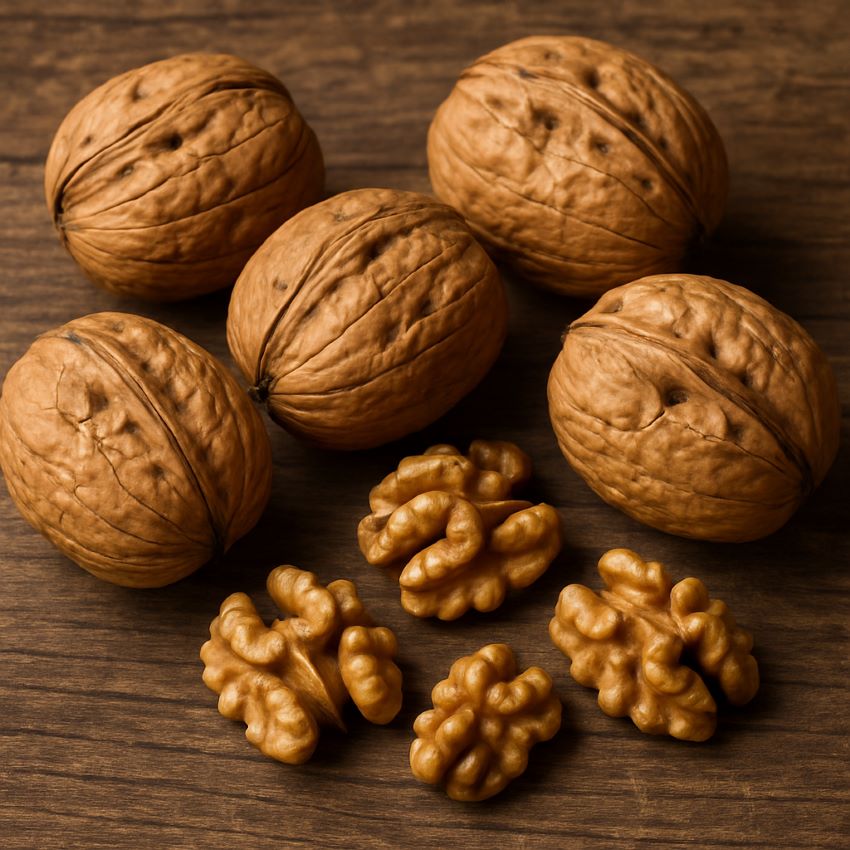
Walnuts are edible seeds of trees in the Juglans genus, with Juglans regia being one of the major cultivated species.
They are recognized by their:
Walnuts are commonly used in:
Modern research continues to investigate walnuts as sources of unsaturated fatty acids, protein, polyphenols and other bioactive compounds. A 2024 review describes walnut kernels as rich in bioactive compounds and examines their potential nutritional and functional-food relevance.
Both foods are nutrient-dense, but the most important differences are found in their fatty-acid profiles, bioactive compounds and culinary characteristics.
Fat is a major component of both pine nuts and walnuts.
However, the composition is different.
Walnuts are particularly notable because they contain alpha-linolenic acid (ALA), a plant-based omega-3 fatty acid. This is one reason walnuts receive significant attention in nutritional research.
Pine nuts, meanwhile, are notable for their distinctive fatty-acid composition, including pinolenic acid in several commercially important species. Research on pine nut oil has investigated pinolenic acid and other characteristic fatty acids, although much of the mechanistic evidence for specific physiological effects comes from laboratory and animal research rather than definitive human clinical evidence.
If you’re comparing the two from a nutritional perspective, simply asking “Which has more healthy fat?” is too simplistic.
The more useful question is:
What type of fat and what overall nutrient profile does each provide?
This is one of the clearest nutritional distinctions.
Walnuts contain the plant omega-3 fatty acid ALA (alpha-linolenic acid).
Pine nuts contain different fatty acids, including characteristic Δ5-unsaturated fatty acids such as pinolenic acid.
Pinolenic acid should not simply be described as equivalent to ALA. They are chemically different fatty acids with different biological roles.
Research on pine nut oil has investigated pinolenic acid for possible metabolic and appetite-related effects, but the evidence base is substantially different from the large body of human dietary research surrounding walnuts and cardiovascular risk markers.
This distinction is important for evidence-based nutrition content.
Walnuts have been extensively studied in human nutrition research.
A systematic review and meta-analysis of randomized controlled trials found that walnut consumption was associated with reductions in total cholesterol, LDL cholesterol and triglycerides, although the authors also identified heterogeneity and potential sources of bias among studies.
More recent evidence continues to investigate the relationship. A large updated systematic review of randomized trials published in 2024 found that nut consumption overall was associated with moderate reductions in total cholesterol and LDL cholesterol, although certainty differed across outcomes.
A newer GRADE-assessed meta-analysis examining 49 randomized controlled trials likewise reported statistically significant reductions in total cholesterol and LDL cholesterol with walnut intake, while finding no significant overall effect on HDL cholesterol.
Pine nuts also provide unsaturated fats and other nutrients that can fit within a balanced dietary pattern. However, the human clinical evidence specifically evaluating pine nuts is not as extensive as the evidence base for walnuts.
Therefore, it would be inaccurate to claim that pine nuts provide exactly the same cardiovascular evidence as walnuts.
Both pine nuts and walnuts are relatively energy-dense.
That does not mean they should automatically be avoided when managing body weight.
Nuts can contribute fat, protein, fiber and other nutrients to the diet, and their combination of nutrients may support satiety.
The practical issue is portion size.
A small serving of nuts can provide substantial calories, so replacing less nutritious foods with an appropriate portion can be more meaningful than simply adding nuts on top of an existing diet.
There is no universal answer.
Your overall dietary pattern, total energy intake, activity level, food choices and portion sizes matter more than choosing pine nuts over walnuts solely because of their name.
Both pine nuts and walnuts provide plant-based protein.
Walnut protein has attracted interest in food science because researchers are exploring its extraction, modification and use in functional foods and dietary products.
A 2024 review found that walnut and walnut meal can serve as sources of plant protein and discussed approaches for improving their functional properties. The review also highlighted challenges involving antinutritional factors, allergenicity and protein functionality.
Pine nuts also contribute plant protein, although their commercial identity is generally more strongly associated with flavor, oil, culinary applications and premium ingredient use than with protein extraction.
Both nuts contain compounds beyond basic macronutrients.
Walnuts contain polyphenols and other bioactive compounds that have been investigated extensively.
Recent reviews have examined walnut polyphenols—including compounds associated with the kernel and other walnut tissues—and potential applications in food and functional-ingredient research.
Pine nuts also contain bioactive compounds and characteristic lipids.
A broad 2026 review of nuts and their bioactive compounds describes nuts as sources of unsaturated fatty acids, polyphenols and other compounds being investigated for their potential roles in human health.
However, the presence of an antioxidant or bioactive compound should not automatically be interpreted as proof that consuming the food prevents or treats a particular disease.
For chefs and food manufacturers, flavor and texture can be just as important as nutrition.
Pine nuts generally have:
Their subtle character allows them to complement herbs, vegetables, cheese, grains and sauces without overpowering the primary ingredients.
Walnuts generally provide:
Their more pronounced flavor makes walnuts useful when the nut itself should be noticeable in the final product.
The two can sometimes be substituted, but they are not interchangeable in every recipe.
Pine nuts are strongly associated with traditional pesto.
Their mild flavor allows basil, garlic, cheese and olive oil to remain prominent while contributing richness and texture.
Walnuts can also be used to make walnut pesto.
The resulting pesto typically has a:
Therefore, for traditional pesto, pine nuts provide the classic ingredient profile, while walnuts can create a distinctive alternative.
Walnuts have a particularly strong position in baking.
They are commonly incorporated into:
Pine nuts can also be used in baking, particularly in:
The choice depends largely on whether the product needs crunch and strong nut flavor or subtle richness and delicate texture.
Both can work exceptionally well in salads.
Pine nuts are useful when the salad requires:
Walnuts are useful when the salad requires:
Walnuts pair particularly well with ingredients such as apples, pears, leafy greens, cheese and dried fruit.
Pine nuts work particularly well with basil, spinach, arugula, tomatoes, roasted vegetables and Mediterranean-style ingredients.
Both pine nuts and walnuts can be processed into specialty oils.
Pine nut oil is valued for its distinctive flavor and fatty-acid profile.
Research has focused on compounds such as pinolenic acid and the potential functional properties of pine nut oil. However, claims about specific health outcomes should be made cautiously because evidence varies by study type and pine species.
Walnut oil is valued for:
Walnut oil can provide a different sensory profile from pine nut oil, making the two suitable for different culinary applications.
The comparison becomes even more interesting when viewed from a commercial perspective.
Food manufacturers evaluate nuts according to much more than nutrition.
Key factors include:
Pine nuts can be developed into:
Walnuts can be developed into:
One of the most interesting developments in the pine nut sector is the growing interest in value-added processing and resource efficiency.
Rather than treating processing residues as waste, researchers are investigating whether components such as skins and other by-products can be recovered for food, fiber or bioactive applications.
This aligns with a broader food-industry movement toward:
Research on tree nuts more broadly has also explored their potential for plant-based, prebiotic, probiotic and synbiotic food development. Pine nuts and walnuts are among the tree nuts considered in this emerging research area.
Walnuts are also moving beyond traditional whole-kernel applications.
Researchers are investigating walnut:
A 2024 review of walnut protein specifically examined extraction, modification, functional properties and potential applications in functional foods and dietary products.
Meanwhile, research into walnut polyphenols is examining ways to characterize and recover bioactive compounds from different walnut components.
These developments demonstrate an important shift:
The future of premium nuts is not limited to selling whole kernels.
The industry is increasingly exploring ways to create multiple value streams from the same agricultural resource.
Neither pine nuts nor walnuts can accurately be labeled universally “more sustainable” without specifying the production system.
Environmental performance can depend on:
For pine nuts, the situation can be particularly complex because some production systems are associated with forest ecosystems and non-timber forest products.
For walnuts, orchard management, irrigation, climate conditions and processing efficiency are important considerations.
A responsible sustainability comparison therefore needs to consider the specific origin and supply chain, rather than relying on a simple nut-versus-nut claim.
Price can change significantly depending on:
For B2B buyers, comparing the sticker price alone can be misleading.
A better purchasing equation is:
Total sourcing value = price + quality + usable yield + consistency + food safety + packaging + logistics + supplier reliability
This approach is particularly important for restaurants, distributors, food manufacturers and international importers.
For international buyers, the sourcing decision involves additional considerations.
A professional supplier should be able to communicate:
Buyers increasingly want transparent information about where their ingredients originate.
Important specifications can include:
Consistent processing can help maintain product quality and reduce variability between shipments.
Export-oriented suppliers should have appropriate food-safety controls and documentation for their target markets.
A premium product is commercially useful only when buyers can obtain it consistently.
Afghanistan has a long history of producing high-value agricultural products, including pine nuts.
Afghan pine nuts are particularly relevant to buyers interested in specialty-origin products and premium ingredients.
For an international pine nut business, origin can become an important component of the product story—but origin claims should always be supported with accurate sourcing and traceability information.
For businesses purchasing Afghan pine nuts, important questions include:
These questions help distinguish a professional B2B supplier from a commodity reseller.
There is no scientifically responsible universal answer that one is simply “healthier.”
Walnuts have a particularly strong evidence base concerning their fatty-acid profile and effects on blood lipid markers. Recent meta-analyses of randomized trials have reported reductions in LDL cholesterol and total cholesterol associated with walnut intake.
Pine nuts provide unsaturated fats, plant protein and other nutrients and have distinctive fatty acids such as pinolenic acid. However, specific health claims concerning pine nut oil or pinolenic acid should be interpreted carefully because much of the mechanistic literature has involved laboratory or animal studies.
Therefore:
Walnuts have particularly strong human clinical evidence for certain lipid outcomes, while pine nuts offer a different nutritional and culinary profile.
That is a more accurate conclusion than declaring one universally superior.
The answer depends on your objective.
Pine nuts may be the better fit.
Walnuts may be more suitable.
Pine nuts are the classic choice.
Walnuts are particularly versatile.
Both offer opportunities, but their flavor and fatty-acid profiles differ.
The decision should consider quality, origin, consistency, specifications, processing, pricing and supply reliability, not just nutritional differences.
Not universally. Both provide valuable nutrients, but their nutritional profiles differ. Walnuts have particularly strong human research concerning blood lipid outcomes, while pine nuts have a distinctive fatty-acid composition that includes pinolenic acid.
Pine nuts contain different fatty acids from walnuts. Walnuts are particularly notable for ALA, a plant-based omega-3 fatty acid. Pine nuts contain characteristic fatty acids such as pinolenic acid.
Both contain plant protein. Actual values vary by species, variety, origin and serving size, so product-specific nutrition information is the appropriate source for precise comparisons.
Yes. Walnuts can make an excellent pesto, but the result will have a stronger and more earthy nut flavor than traditional pine-nut pesto.
Yes, in some recipes. However, pine nuts generally provide a softer texture and more delicate flavor, so the final product will be different.
Both provide unsaturated fats. The more meaningful comparison is their fatty-acid composition rather than simply total fat.
Pine nut prices vary considerably according to species, origin, harvest, kernel yield, grade, processing and market conditions.
Human clinical research has found that walnut-enriched diets can improve several blood lipid measures, including LDL cholesterol and total cholesterol. However, dietary effects should not be interpreted as treatment for cardiovascular disease.
Often, yes. Both can work in salads, sauces, bakery products and desserts, but they create different flavors and textures.
| Category | Pine Nuts | Walnuts |
|---|---|---|
| Flavor | Mild, buttery | Rich, earthy |
| Texture | Soft, creamy | Crunchy |
| Flavor intensity | Subtle | Stronger |
| Plant protein | Yes | Yes |
| Unsaturated fats | High | High |
| ALA omega-3 | Not the defining feature | Particularly notable |
| Pinolenic acid | Characteristic of several pine species | Not characteristic |
| Traditional pesto | Excellent | Alternative |
| Baking | Excellent | Excellent |
| Snacking | Good | Excellent |
| Salads | Excellent | Excellent |
| Oil production | Yes | Yes |
| Butter/paste | Yes | Yes |
| Functional-food research | Emerging | Extensive |
| Best application | Premium culinary ingredient | Snack + ingredient |
| Universal winner? | No | No |
For buyers seeking specialty-origin pine nuts, Afghan pine nuts can offer an opportunity to build differentiated products around origin, quality and premium positioning.
RG Pinenuts focuses on supplying Afghan pine nut products for international markets, including premium pine nut kernels and value-added products such as pine nut oil and pine nut butter.
For B2B buyers, restaurants, distributors, retailers and food manufacturers, the most important sourcing considerations include:
A premium pine nut is more than an ingredient. Its value can come from the combination of origin, quality, processing, flavor, consistency and supply-chain reliability.
Pine nuts and walnuts are both valuable foods, but they excel in different areas.
Pine nuts stand out for their delicate buttery flavor, soft texture, specialty culinary applications and distinctive fatty-acid profile.
Walnuts stand out for their robust flavor, crunchy texture, versatility, plant-based ALA omega-3 content and comparatively extensive human clinical research concerning blood lipid outcomes.
The best choice ultimately depends on what you are trying to achieve.
For consumers, that may mean choosing according to taste, dietary needs and portion size.
For chefs, it may come down to flavor and texture.
For food manufacturers, it may involve formulation, processing and product positioning.
For international buyers, it may depend on origin, quality, specifications, price and supply reliability.
Rather than asking which nut is universally better, the more useful question is:
Which nut is the right fit for your specific nutritional, culinary or commercial objective?
This article is for educational purposes and is not medical advice. Nutritional composition varies according to species, cultivar, origin, growing conditions, processing and serving size. Individuals with allergies or medical conditions should obtain personalized advice from an appropriately qualified professional.