
Pine nuts vs peanuts is an increasingly useful comparison for consumers, chefs, nutrition-conscious shoppers, food manufacturers, and businesses sourcing nuts and nut-based ingredients.
Although both are commonly called “nuts,” they are botanically different. Pine nuts are edible seeds from pine trees, while peanuts are legumes that develop underground. They also differ in flavor, texture, protein, fatty-acid composition, culinary applications, processing, market positioning, and allergen considerations.
So, which is better: pine nuts or peanuts?
The answer depends on what you are comparing. For premium culinary applications, pine nuts offer a distinctive buttery flavor and specialty positioning. Peanuts provide a familiar roasted flavor, substantial plant protein, versatile processing options, and broad applications ranging from peanut butter to snacks and confectionery.
This guide compares pine nuts vs peanuts across nutrition, health research, taste, texture, culinary applications, food manufacturing, processing innovations, sustainability considerations, and sourcing.
Quick answer: Pine nuts are prized for their delicate buttery flavor, soft texture, and distinctive fatty-acid profile, while peanuts are valued for their protein, unsaturated fats, affordability, versatility, and extensive use in snacks, peanut butter, sauces, confectionery, and food manufacturing.
| Feature | Pine Nuts | Peanuts |
|---|---|---|
| Botanical classification | Seeds of pine trees | Legume |
| Growing location | Pine trees/forests | Underground pods |
| Flavor | Delicate, buttery, mildly sweet | Nutty, roasted, savory |
| Texture | Soft, tender, creamy | Firm, crunchy or creamy when processed |
| Protein | Moderate | Relatively high |
| Fat | High in unsaturated fats | High in unsaturated fats |
| Distinctive component | Pinolenic acid | Oleic acid, linoleic acid, polyphenols and phytosterols |
| Common uses | Pesto, sauces, salads, rice, gourmet foods | Peanut butter, snacks, sauces, confectionery, flour |
| Processing formats | Kernels, pieces, roasted kernels, oil, butter | Whole, roasted, flour, meal, butter, oil |
| Premium positioning | Specialty/gourmet | Mainstream and industrial |
| Allergy consideration | Tree-seed allergy possible | Major food allergen |
| Typical flavor role | Delicate richness | Stronger roasted nuttiness |
Nutritional composition varies according to species, cultivar, growing conditions, processing, preparation, and serving size.
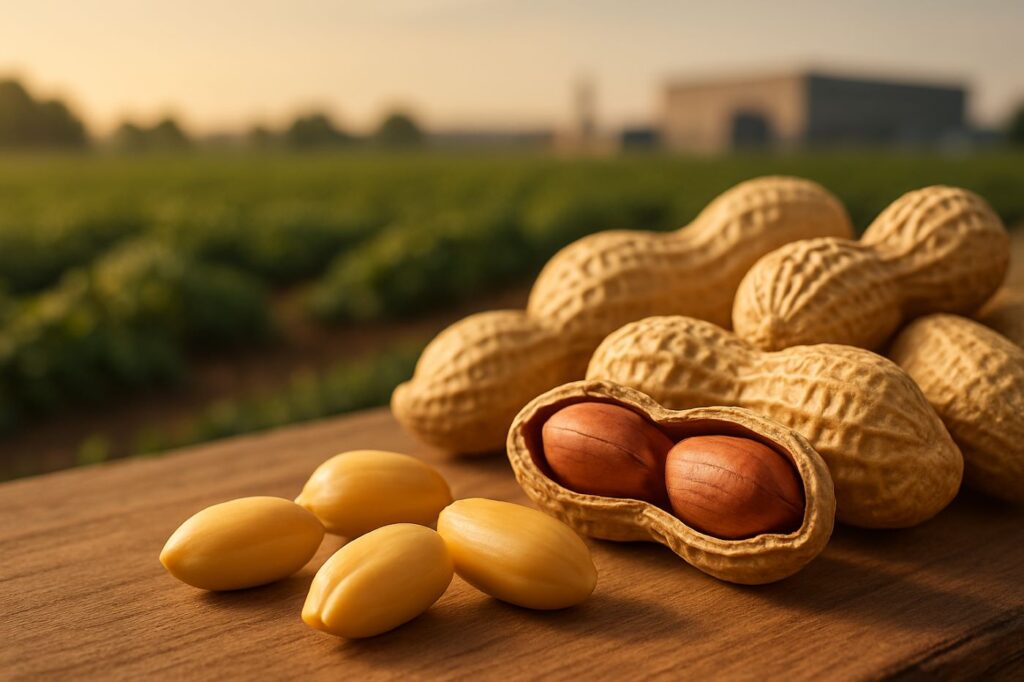
Pine nuts are edible seeds harvested from specific pine species.
They are technically seeds rather than botanical nuts, although they are widely categorized as culinary nuts.
Pine nuts are known for their:
They are especially popular in Mediterranean, Middle Eastern, Asian, and international cuisine.
Common applications include:
One of the most distinctive scientific characteristics of pine nuts is their fatty-acid composition, particularly pinolenic acid.
Research has investigated pinolenic acid in relation to lipid metabolism, inflammation, appetite regulation, and other biological mechanisms. However, many of these findings remain preliminary or require additional human research.
Peanuts are the seeds of Arachis hypogaea, a legume belonging to the same botanical family as beans and lentils rather than tree nuts.
Despite this botanical difference, peanuts are commonly grouped with nuts because of their culinary and nutritional characteristics.
Peanuts are widely consumed as:
Peanuts are particularly valuable to food manufacturers because they offer a combination of protein, fat, flavor, functionality, and relatively broad processing versatility.
Both foods are nutrient-dense, but their nutritional profiles are different.
The main areas to compare include:
Recent scientific reviews describe both tree nuts and peanuts as nutrient-dense foods containing unsaturated fatty acids, fiber, minerals, vitamins, polyphenols, phytosterols, and other bioactive compounds.
One of the most important nutritional characteristics of peanuts is their protein content.
Peanuts can contribute substantial plant protein to:
Pine nuts also contain protein, but their culinary role is more strongly associated with fat, flavor, and texture.
For food manufacturers developing protein-focused products, peanuts can therefore be particularly useful.
Both pine nuts and peanuts contain significant amounts of unsaturated fats.
However, their fatty-acid profiles differ.
Pine nuts contain several unsaturated fatty acids and are particularly notable for pinolenic acid, a polyunsaturated fatty acid associated with pine nut oil. Reviews report that pinolenic acid can account for a substantial fraction of pine nut oil fatty acids depending on the species and source.
Peanuts contain significant amounts of:
High-oleic peanut varieties have also been developed through breeding programs to increase the oleic-to-linoleic ratio and improve characteristics such as oxidative stability. Research on high-oleic peanuts has investigated nutritional, sensory, and potential metabolic differences.
Both foods can contribute dietary fiber, especially when consumed in less-processed forms.
Fiber is relevant to:
However, the precise amount depends on serving size and preparation.
For example, peanut butter can have a different nutritional profile from whole peanuts because processing changes the food matrix and serving pattern.
Pine nuts and peanuts provide a variety of micronutrients.
Depending on the specific product and serving size, both can contribute:
Peanuts are particularly recognized for their combination of protein, unsaturated fats, vitamins, minerals, and phytochemicals.
Pine nuts likewise contribute minerals while offering a distinctive fatty-acid and flavor profile.
Rather than identifying one food as universally superior, nutrition should be considered within the context of the entire diet.
Peanuts contain numerous bioactive compounds, including:
Scientific reviews have investigated these compounds in relation to oxidative stress, inflammation, cardiovascular health, and metabolic processes.
Pine nuts also contain bioactive compounds and distinctive fatty acids, including pinolenic acid.
A recent broad review of nuts and peanuts highlights growing scientific interest in bioactive compounds, processing, bioaccessibility, gut microbiota interactions, and the role of nuts in healthy dietary patterns.
Both foods can fit into a balanced diet.
However, health research should be interpreted carefully.
A systematic review of 19 clinical studies examining peanuts and peanut-derived products reported improvements in several metabolic measures across the included studies, including some measures of glycemia, lipids, body composition, and endothelial function.
The authors also emphasized that larger studies, longer interventions, and more diverse populations are needed to clarify the evidence.
This is an important distinction:
Research supports peanuts as a nutrient-dense food with potentially favorable cardiometabolic effects, but that does not mean peanuts are a treatment for cardiovascular disease or diabetes.
Pine nuts have attracted scientific interest because of pinolenic acid.
Researchers have investigated whether pine nut oil and pinolenic acid may influence:
A review of the literature describes pinolenic acid as a distinctive fatty acid found in pine nut oil and summarizes findings from cellular, animal, and human research.
However, the evidence should not be overstated.
Some research suggests potential metabolic effects, but more high-quality human trials are required before specific health claims can be considered established.
Both foods are relatively energy-dense.
That does not automatically mean they cause weight gain.
A systematic review examining metabolizable energy in tree nuts and peanuts found that the amount of energy actually available from nuts can differ from what standard food-composition calculations suggest because some fat remains trapped within plant cell structures and is not completely digested.
This is one reason nutrition research increasingly considers the food matrix, not simply the calorie number printed in a database.
Both pine nuts and peanuts can therefore be incorporated into balanced diets, with portion size and overall dietary pattern remaining important.
The culinary difference between these foods is significant.
Pine nuts generally offer:
They tend to complement rather than dominate a dish.
Peanuts generally provide:
Peanut flavor can become especially intense after roasting.
The best choice depends on the recipe.
Pine nuts are the traditional choice for classic basil pesto.
They provide a smooth, buttery richness that integrates naturally with:
Peanuts can technically be used in alternative pesto recipes, but the flavor profile is substantially different.
If the objective is a traditional-style pesto, pine nuts are the characteristic ingredient.
If the objective is an innovative or lower-cost variation, peanuts can create an entirely different product concept.
This is one category where peanuts have a clear product-format advantage.
Peanuts are extensively processed into:
Pine nuts can also be processed into specialty nut butter, but pine nut butter occupies a much more specialized premium position.
For manufacturers targeting mass-market spreads, peanuts offer established consumer recognition and processing infrastructure.
For premium specialty products, pine nut butter can provide differentiation.
The two ingredients offer different commercial advantages.
Pine nuts are particularly suitable for:
Peanuts are particularly suitable for:
This means manufacturers should not simply compare nutritional values.
They should evaluate functionality, flavor, cost, supply, processing, consumer expectations, and target market.
The nut and seed industry continues to evolve through improvements in processing, quality control, packaging, and value-added ingredients.
Optical and automated sorting technologies can improve consistency by identifying differences in:
This is increasingly important for export-quality products.
Roasting affects:
Controlled roasting can help manufacturers create consistent sensory profiles.
However, excessive heat can also affect some nutrients and flavor compounds.
Processing should therefore be optimized for the specific product.
Both pine nuts and peanuts can be processed into oils.
Modern extraction technologies increasingly focus on:
Pine nut oil is particularly interesting because of its distinctive fatty-acid profile.
Peanut oil benefits from a much larger commercial ecosystem and includes conventional and high-oleic varieties.
One important development in peanut agriculture is the expansion of high-oleic peanut varieties.
These peanuts contain substantially more oleic acid relative to conventional varieties.
Research has examined their:
High-oleic peanuts can offer improved oxidative stability, making them particularly relevant for food manufacturing and shelf-life management.
Modern food research increasingly explores ways to turn nut processing by-products into useful ingredients.
Research has examined compounds from:
Peanut skins, for example, contain polyphenolic compounds that have attracted research interest for potential food and functional-ingredient applications.
A recent review of nuts and peanuts also highlights increasing research interest in nut coproducts as functional ingredients.
This creates opportunities for a more circular food-processing model.
Sustainability cannot be reduced to a simple statement that one product is automatically better.
Environmental performance depends on:
Peanuts are legumes and can play a different role in agricultural systems from tree-based pine nut production.
Pine nuts can originate from forest or woodland systems depending on species and region, creating a different set of sourcing and management considerations.
For commercial buyers, the most meaningful sustainability questions are often specific to the actual supply chain and origin.
Pricing varies according to:
Pine nuts often occupy a more specialized premium category because of their harvesting, processing, limited supply, and culinary positioning.
Peanuts generally have broader production and processing infrastructure, which allows them to serve large-scale consumer markets.
This distinction is particularly important for food businesses.
A product does not necessarily need the cheapest ingredient.
It needs the ingredient that provides the best combination of:
Cost + functionality + consumer value + quality + availability.
For international buyers, sourcing decisions should extend beyond nutritional specifications.
A professional supplier evaluation should include:
For pine nuts, origin can be particularly important because flavor, kernel characteristics, species, and harvesting practices can vary between producing regions.
For peanuts, variety and processing format can be equally important.
Afghan pine nuts represent a specialty product with a distinctive geographic origin.
For an exporter such as RG Pinenuts, the opportunity is to communicate measurable product characteristics rather than relying only on broad marketing language.
Important product information can include:
This type of first-hand information can make a commercial website more useful to buyers and can differentiate it from generic comparison articles.
This is an important distinction.
Peanuts are recognized as a major food allergen in many regulatory jurisdictions.
Pine nuts can also cause allergic reactions in susceptible individuals, although the regulatory classification and prevalence differ by jurisdiction.
Businesses handling either product should maintain appropriate:
For commercial products, allergen requirements should always be checked against the regulations of the destination market.
There is no scientifically responsible universal answer.
Both are nutrient-dense foods that can provide unsaturated fats, minerals, fiber, and bioactive compounds. A recent review covering nuts and peanuts found broad evidence connecting nut consumption with favorable dietary and health outcomes, while also emphasizing the importance of composition, processing, bioaccessibility, and gut-microbiota interactions.
Peanuts have a substantial body of clinical research investigating metabolic and cardiovascular outcomes.
Pine nuts have a distinctive research interest around pinolenic acid and pine nut oil.
Therefore:
Peanuts may be especially attractive when protein, affordability, and versatility are priorities.
Pine nuts may be especially attractive when distinctive flavor, specialty applications, and a unique fatty-acid profile are priorities.
The appropriate choice depends on the individual food, diet, and application.
No. Pine nuts are edible seeds from pine trees, while peanuts are legumes. They differ botanically, nutritionally, and commercially.
Generally, peanuts are particularly rich in protein and are widely used in protein-containing foods. Pine nuts also provide protein but are more commonly valued for their flavor, texture, and fat profile.
Neither can be universally classified as healthier. Both provide valuable nutrients, but their nutritional compositions and research bases differ.
Clinical research has investigated peanut consumption in relation to cardiovascular and metabolic risk factors, with systematic reviews reporting potentially favorable effects on several markers. More research is still needed to establish the effects across different populations and consumption patterns.
Pine nuts contain pinolenic acid, which has been investigated for potential appetite and metabolic effects. However, the evidence is not sufficient to describe pine nuts as a proven weight-loss treatment.
Yes, but the resulting pesto will taste different. Peanuts have a stronger roasted flavor and different texture, while pine nuts provide the more traditional delicate and buttery profile.
In many markets, peanuts are generally positioned as a more accessible commodity ingredient, while pine nuts often command premium prices. Actual pricing varies according to origin, grade, processing, supply, and market conditions.
Botanically, pine nuts are seeds. They are commonly treated as culinary nuts.
Botanically, peanuts are legumes rather than true nuts.
Peanuts are generally the stronger choice when protein content is a primary consideration.
Pine nuts are the traditional choice for classic pesto.
Peanuts are the obvious choice because peanut butter is specifically produced from peanuts.
The simplest way to understand the comparison is to look at their primary strengths.
Best known for:
Best known for:
| Category | Pine Nuts | Peanuts |
|---|---|---|
| Botanical identity | Pine seed | Legume |
| Flavor | Delicate and buttery | Stronger and roasted |
| Texture | Soft | Crunchy or creamy |
| Protein role | Moderate | Strong |
| Fat profile | Unsaturated fats + pinolenic acid | Unsaturated fats + oleic/linoleic acids |
| Pesto | Excellent traditional ingredient | Alternative ingredient |
| Peanut butter | Specialty alternative | Primary ingredient |
| Gourmet positioning | Strong | Variable |
| Mass-market applications | More limited | Extremely broad |
| Oil production | Specialty | Major commercial category |
| Research interest | Pinolenic acid and metabolic mechanisms | Cardiometabolic health, phytochemicals and protein |
| Allergy consideration | Potential allergen | Major food allergen |
| Export considerations | Origin and specialty grade | Variety, grade and processing |
| Consumer positioning | Premium/specialty | Mainstream + premium |
The pine nuts vs peanuts comparison reveals two very different ingredients that happen to share some nutritional characteristics.
Pine nuts offer a distinctive combination of:
Peanuts offer:
Neither ingredient is universally “better.”
For traditional pesto, gourmet sauces, specialty foods, premium toppings, and distinctive culinary applications, pine nuts can be highly valuable.
For protein-rich snacks, peanut butter, confectionery, sauces, flour, and high-volume food production, peanuts offer exceptional versatility.
For consumers, the best choice depends on nutritional needs, dietary preferences, allergies, portion size, and culinary purpose.
For businesses, the decision should additionally consider quality, price, processing, supply consistency, origin, food safety, packaging, and target market.
pine nuts vs peanuts
Pine Nuts vs Peanuts: Nutrition, Benefits, Taste & Uses
/pine-nuts-vs-peanuts/
Pine nuts vs peanuts: compare nutrition, protein, healthy fats, taste, benefits, calories, culinary uses, processing, allergies, and sourcing.
Pine Nuts vs Peanuts: Nutrition, Benefits, Taste, Uses & Key Differences
Google’s current documentation emphasizes Search Essentials, useful and reliable content, appropriate technical implementation, and helping Google understand page content through elements such as structured data.
For an RG Pinenuts page, add information your company can actually verify:
This gives the page information that generic competitors cannot easily reproduce.
Consider adding original images showing:
Use descriptive, accurate image filenames and alt text.
Link this article naturally to related pages such as:
This creates a stronger topical structure around the main commercial subject.
Because this article discusses nutrition and health, use reputable scientific sources rather than unsupported claims.
The current evidence base includes systematic reviews examining peanuts, tree nuts, metabolizable energy, bioactive compounds, and cardiometabolic outcomes.
Include:
This helps users understand who is responsible for the content.
This article intentionally addresses:
Informational intent:
“What is the difference between pine nuts and peanuts?”
Nutritional intent:
“Pine nuts vs peanuts nutrition”
Health intent:
“Are pine nuts healthier than peanuts?”
Culinary intent:
“Pine nuts vs peanuts for pesto”
Commercial intent:
“Buy Afghan pine nuts”
B2B intent:
“Wholesale pine nut supplier”
Covering these intents naturally can make the page useful for a broader set of related searches.
Do not repeatedly insert:
“pine nuts vs peanuts”
into every paragraph.
Use natural variations such as:
Google’s current search guidance is centered on useful content rather than mechanically repeating keywords.
The strongest version of this page should contain information that demonstrates genuine knowledge of the product and supply chain.
For RG Pinenuts, that could mean documenting:
Origin → Harvesting → Processing → Sorting → Storage → Packaging → Quality Control → Export
That first-hand information can be substantially more valuable than simply making the article longer.
Pillar Page:
Pine Nuts vs Peanuts
Supporting Pages:
This structure allows the comparison page to support a broader pine-nut topical authority strategy rather than trying to rank one page for every keyword.
The objective should be to maximize the page’s probability of earning strong organic visibility, not promise a #1 position.
Google’s search systems continually evaluate relevance, usefulness, technical accessibility, spam compliance, and many other signals. Current Google documentation also covers AI features, title links, snippets, structured data, and other search appearances.
For the strongest competitive version of this page, combine this article with:
Original Afghan pine-nut expertise + scientific citations + first-hand photography + product data + strong internal linking + technically sound SEO + authoritative backlinks + excellent page experience.