
Bulk Afghan pine nuts for U.S. distributors represent a specialized sourcing opportunity for wholesalers, specialty-food distributors, retailers, foodservice companies, restaurants, bakeries, and food manufacturers seeking premium-origin pine nuts with a distinctive product story.
Afghan Chilgoza pine nuts, primarily associated with Pinus gerardiana, are valued for their elongated appearance, rich flavor, delicate texture, and premium positioning. For U.S. distributors, however, successful sourcing requires more than attractive origin. Consistent product specifications, professional processing, quality control, packaging, traceability, documentation, and dependable supply are essential.
A professional Afghan pine nut exporter should therefore provide a complete B2B supply solution—from sourcing and processing in Afghanistan through bulk packaging and export preparation.
The U.S. specialty-food market provides opportunities for differentiated nuts and ingredients with strong geographic and cultural identities.
Afghan pine nuts can serve distributors looking for products that offer:
For distributors, the commercial opportunity is not simply to sell another nut. It is to introduce a differentiated ingredient that can be positioned around origin, quality, culinary versatility, and premium sourcing.
Chilgoza pine nuts are the edible seeds associated with Pinus gerardiana, a pine species native to mountainous areas of Afghanistan and the wider Hindu Kush–Himalayan region.
The nuts are traditionally harvested and consumed in Afghanistan and neighboring regions. Their elongated shape and rich, buttery character distinguish them from many other pine nut varieties found in international markets.
For U.S. distributors, accurate product identification is important because “pine nuts” is a broad commercial category containing seeds from multiple pine species.
A supplier should therefore identify the species, origin, product form, grade, and applicable specifications rather than relying solely on the generic term “pine nuts.”
Bulk purchasing allows U.S. distributors to source pine nuts for multiple downstream channels.
Potential applications include:
Distributors can supply Afghan pine nuts to specialty-food retailers looking for premium international ingredients.
Restaurants may use pine nuts in:
Pine nut kernels can provide:
Bulk kernels can be incorporated into:
Distributors may purchase bulk product and supply it to retailers under established brands or private-label programs, subject to applicable regulatory and contractual requirements.
For many commercial applications, pine nut kernels are more convenient than in-shell pine nuts.
Kernels can reduce downstream processing requirements and allow manufacturers and foodservice operators to use the ingredient directly.
When evaluating bulk Afghan pine nut kernels, distributors should consider:
The correct specification depends on the buyer’s application.
A restaurant distributor may prioritize appearance and flavor, while a food manufacturer may place greater emphasis on consistency, microbiological controls, oxidation stability, packaging, and repeatability between shipments.
A professional Afghan pine nut exporter can potentially supply several commercial formats.
Suitable for foodservice, specialty retail, restaurants, and premium ingredient distribution.
Suitable for:
In-shell products can appeal to specialty markets and traditional food channels where the shell is part of the product experience.
Pine nut oil can provide a premium value-added product for culinary and specialty-food applications.
Pine nut butter creates another potential value-added category for specialty retailers and food manufacturers.
Choosing a supplier based only on price can create problems later in the supply chain.
A better approach is to evaluate the supplier across quality, consistency, documentation, processing, packaging, logistics, and commercial reliability.
Ask the exporter to clearly identify:
Origin should be supported by appropriate documentation rather than simply used as a marketing statement.
A capable processor should have defined procedures for:
Before purchasing, distributors should establish written specifications covering the characteristics that matter for their intended market.
Batch or lot identification can help distributors investigate quality issues, manage recalls where necessary, and maintain better supply-chain visibility.
Packaging should protect the product throughout international transportation and storage.
A professional exporter should understand the documentation required for the product, destination, shipment, and buyer.
One successful sample is not enough.
Distributors need confidence that future shipments will meet agreed specifications.
The value of Afghan pine nuts can increase substantially through professional post-harvest processing.
A commercial processing workflow may include:
Raw Material → Inspection → Cleaning → Shelling → Kernel Separation → Sorting → Grading → Quality Inspection → Packaging → Storage → Export
Each stage can affect the final product.
Incoming pine nuts should be inspected before entering processing.
Foreign material and unsuitable material should be removed.
Where kernels are required, shelling must be performed carefully to minimize unnecessary kernel damage.
Sorting can remove defective, damaged, discolored, or unsuitable pieces.
Product can be separated according to agreed commercial specifications.
The finished batch should undergo final quality review before packaging.
Packaging should be selected according to the product, transportation conditions, storage requirements, and target shelf life.
Modern food processing is moving beyond purely manual inspection.
Technology such as optical imaging, spectroscopy, machine learning, automated sorting, and non-destructive inspection is increasingly being investigated for food-quality applications.
A 2026 study in LWT – Food Science and Technology developed a tri-modal deep-learning approach combining image, spectral, and texture information to detect deterioration in pine nuts. The research reported high classification performance for species identification and acidification and oxidation grading, demonstrating the potential of non-destructive technologies for evaluating internal quality.
For commercial processors, this direction is important because some forms of deterioration may not be obvious from external appearance alone.
Future-oriented pine nut processing can increasingly combine:
These technologies should be viewed as tools that complement—not automatically replace—validated food-safety and quality systems.
One of the most important considerations for bulk pine nuts is oxidative stability.
Pine nuts contain significant amounts of oil. During storage and transportation, exposure to oxygen, heat, light, moisture, and unfavorable conditions can contribute to quality deterioration.
For U.S. distributors, this means the supply chain matters just as much as the initial product quality.
A strong quality-management approach should consider:
Distributors should ask suppliers how they control these variables.
Packaging technology is becoming an increasingly important area of nut research.
In 2026, researchers investigated active antioxidant packaging films incorporating Chilgoza pine nut shell extract. The experimental packaging demonstrated improved barrier and antioxidant properties and reduced oxidation indicators in stored pine nuts compared with the control film.
The study is particularly interesting because it connects two objectives:
This research remains an emerging technology rather than a universal commercial packaging standard. Any packaging used for U.S. distribution must be evaluated for food-contact compliance, commercial scalability, cost, and suitability for the specific product.
Packaging should be designed around the entire supply chain rather than only the factory.
Potential commercial approaches include:
The ideal solution depends on:
A distributor should request packaging specifications before placing a commercial order.
Importing food into the United States involves regulatory responsibilities that should be addressed before shipment.
The U.S. Food and Drug Administration states that imported human foods must meet applicable U.S. requirements relating to safety, sanitation, labeling, and other regulatory obligations.
FDA also requires Prior Notice for food offered for import into the United States.
The Foreign Supplier Verification Program (FSVP) places responsibilities on covered U.S. importers to conduct risk-based verification of foreign suppliers.
This can involve:
The exact requirements depend on the importer, product, supplier, and applicable exemptions.
For that reason, U.S. distributors should work with their customs broker and regulatory professionals to verify requirements for their specific shipment.
For a U.S. distributor importing directly from Afghanistan, supplier verification is particularly important.
An importer covered by FSVP may need to evaluate:
This makes supplier documentation a commercial asset.
An exporter that can provide organized product specifications, process information, quality documentation, traceability information, and appropriate food-safety records can make the distributor’s supplier-qualification process easier.
Food entering the U.S. market must comply with applicable FDA labeling requirements.
Depending on the product, labeling may involve:
The final label should be reviewed against the specific product and U.S. regulatory requirements before commercial distribution.
Do not assume that an exporter-designed label automatically satisfies U.S. requirements.
U.S. distributors should build a supplier-qualification checklist before purchasing bulk Afghan pine nuts.
Potential documentation may include:
The exact documentation package should be based on the distributor’s risk assessment and customer requirements.
A professional distributor should consider evaluating a representative sample before committing to a large shipment.
A sample assessment can examine:
Are the kernels visually consistent?
Is the aroma clean and characteristic?
Does the flavor match the agreed specification?
Are the kernels crisp and appropriate for the intended use?
Are damaged, rancid, moldy, discolored, or otherwise unsuitable pieces present?
Does the packaging adequately protect the product?
Does the supplier’s documentation correspond to the actual product?
A successful sample should then be followed by a written commercial specification so future shipments can be compared against the same standard.
Bulk pricing depends on numerous variables, so a single generic “Afghan pine nut price” can be misleading.
Important pricing variables include:
The lowest FOB or export price may not produce the lowest landed cost.
U.S. distributors should calculate the total landed cost before comparing suppliers.
Product Cost + Processing/Packaging + Freight + Insurance + Customs/Brokerage + Other Applicable Charges = Estimated Landed Cost
This provides a more useful comparison than comparing supplier quotations based only on the unit product price.
For a distributor, inconsistent quality can create costs throughout the supply chain.
Problems may include:
A slightly higher purchase price may be commercially preferable if it delivers better consistency, documentation, packaging, and supply reliability.
The objective should therefore be value per delivered unit, not simply the lowest quoted price.
Afghan pine nuts can support premium positioning in several categories.
Small consumer packages can target specialty-food shoppers interested in international ingredients.
Chilgoza pine nuts can fit naturally into Middle Eastern, South Asian, and Afghan food channels.
The product can be positioned as a premium-origin ingredient for gourmet applications.
Bulk formats can support restaurant and hospitality distribution.
Food manufacturers can purchase kernels as a functional culinary ingredient.
Private-label programs can create additional value for established distributors.
Potential formats include:
Before launching private-label products, the distributor should confirm:
Private label can transform a commodity-style ingredient into a differentiated branded product.
Sustainability is particularly important for Chilgoza pine nuts because the product depends on natural forest resources.
Responsible sourcing should consider:
Research on Pinus gerardiana has highlighted concerns surrounding regeneration and the effects of intensive harvesting, reinforcing the importance of responsible management of Chilgoza forests.
For U.S. distributors, sustainability claims should be specific and evidence-based.
Avoid vague claims such as “100% sustainable” unless the company has a defined standard and supporting evidence.
An effective commercial supply chain can be represented as:
Afghan Forests → Responsible Collection → Processing → Cleaning → Sorting → Grading → Quality Control → Packaging → Storage → Export → U.S. Import → Distribution → Retail/Foodservice
Every stage creates an opportunity to protect quality.
For U.S. distributors, the most important objective is maintaining product integrity from the origin through final delivery.
That requires coordination between:
Direct sourcing can provide distributors with greater visibility into the origin and processing chain.
Potential advantages include:
However, direct sourcing also means the buyer must conduct proper supplier due diligence.
A professional relationship should be built around documentation, transparency, consistent specifications, communication, and performance.
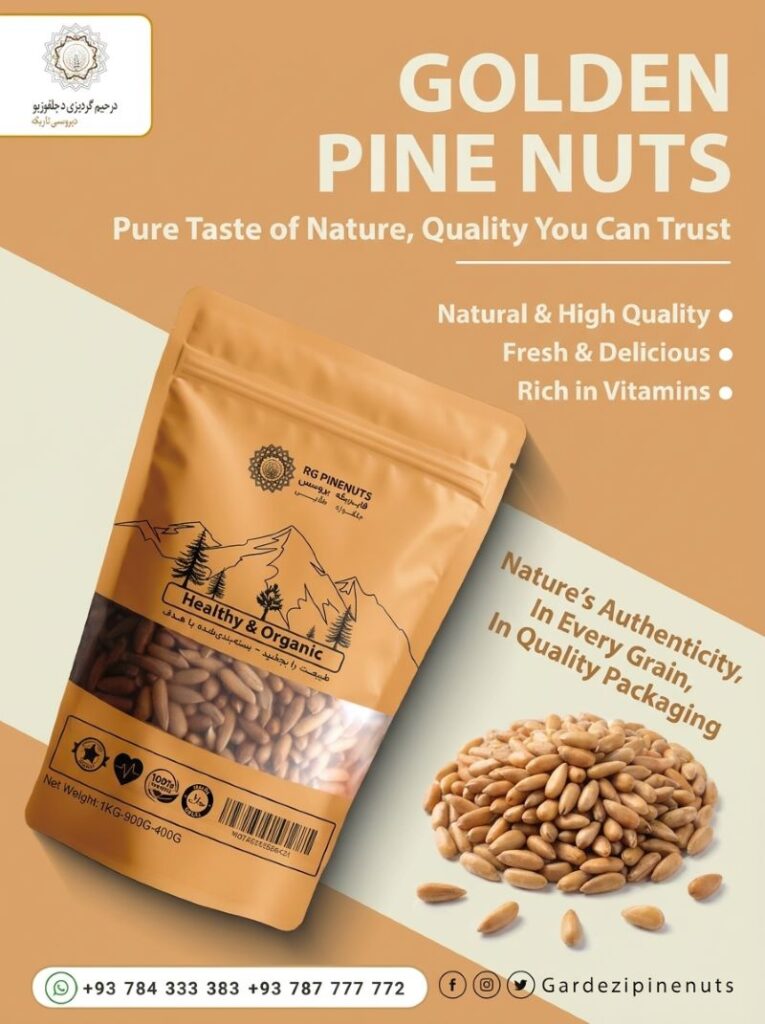
RG Pinenuts is an Afghanistan-based pine nut business founded in 2021, focused on supplying high-quality Afghan pine nuts and related products for international markets.
Its product portfolio includes:
The brand positioning emphasizes quality, hygiene, innovation, and trust, with the tagline “RG Pinenuts — Pure Quality. Trusted Origin.”
For U.S. distribution, the most valuable next step is to connect this positioning with verifiable first-party evidence, including actual processing photographs, product specifications, packaging formats, testing documents where available, traceability procedures, and documented export capabilities.
Any claims regarding certifications, U.S. customers, processing capacity, organic status, or regulatory approvals should be made only where supporting documentation exists.
The purchasing process can be straightforward.
Specify:
Provide:
Choose:
Ask for appropriate:
Evaluate the actual product before scaling.
Work with your U.S. customs broker and regulatory team.
Evaluate the complete delivered cost rather than the product price alone.
Once quality, documentation, logistics, and commercial terms are validated, establish a repeat-order process.
Yes. Afghan pine nuts can be sourced in bulk for wholesale distribution, foodservice, retail, specialty food, and food manufacturing applications, subject to applicable U.S. import requirements.
Afghan Chilgoza pine nuts are edible seeds associated with Pinus gerardiana, a pine species native to mountainous regions of Afghanistan and neighboring areas.
Yes. Bulk pine nut kernels are suitable for distributors, food manufacturers, restaurants, bakeries, confectionery businesses, and other commercial buyers.
Ask about:
Packaging should protect the product from environmental conditions that can accelerate deterioration. The appropriate format depends on the product, shipment, storage conditions, transportation, and required shelf life.
Compare more than price. Evaluate product quality, specifications, processing, food-safety documentation, traceability, packaging, consistency, logistics, communication, and total landed cost.
Potentially, subject to the product, labeling requirements, packaging agreement, minimum order quantity, and applicable U.S. regulations.
Yes. Pine nuts can be used across many restaurant applications, including salads, rice dishes, sauces, pesto, desserts, pastries, and specialty dishes.
Yes. Bulk kernels can be used as ingredients in snack products, bakery items, confectionery, prepared foods, sauces, and other food applications.
For a new supplier relationship, define your specification, request documentation and samples, evaluate the product, confirm U.S. import requirements, calculate landed cost, and then begin with a commercially controlled order.
If you are a U.S. distributor, importer, wholesaler, specialty-food company, restaurant supplier, retailer, or food manufacturer, Afghan pine nuts can provide an opportunity to add a distinctive premium-origin product to your portfolio.
RG Pinenuts can discuss requirements for:
Request a wholesale quotation and provide your required product, quantity, packaging format, destination, and quality specifications.