
Afghan pine nuts USA are gaining attention among importers, specialty food distributors, wholesalers, retailers, restaurants, food manufacturers, and consumers looking for distinctive, premium-origin pine nuts.
Known internationally as Chilgoza pine nuts, the edible seeds of Pinus gerardiana are native to the mountainous regions of Afghanistan and the wider Hindu Kush–Himalayan region. Their elongated shape, rich buttery flavor, delicate texture, and naturally high oil content distinguish them from many commercially available pine nut varieties.
For U.S. buyers, however, premium origin is only one part of the sourcing decision. Consistent quality, processing, food safety, packaging, shelf-life management, traceability, documentation, and dependable international supply are equally important.
A professional Afghan pine nut supplier should therefore provide more than a product. The goal should be to deliver a quality-controlled, export-ready supply solution for the U.S. market.
Afghanistan has a long history of Chilgoza pine production, particularly across its eastern and southeastern forest regions. FAO identifies Pinus gerardiana—commonly called Chilgoza or Chalghoza pine—as a species found in Afghanistan, Pakistan, and India, with its edible kernels entering international trade.
Afghan pine nuts offer several characteristics that make them commercially interesting:
For American importers and food businesses, Afghan origin can also create a differentiated product story in a crowded specialty-nut market.
Afghanistan’s pine nut sector is already connected to international markets. Reporting based on Afghanistan’s Ministry of Industry and Commerce stated that the country exported approximately 1,031 tonnes of pine nuts worth more than $15 million in 2025, with the United States listed among the destination markets.
This international trade activity demonstrates that Afghan pine nuts are not simply a local specialty; they are an established export commodity with commercial relevance beyond Afghanistan.
Afghan Chilgoza pine nuts come from Pinus gerardiana, a pine species native to the northwestern Himalayan and Hindu Kush regions.
FAO describes the species as occurring naturally in Afghanistan, Pakistan, and India. It grows at high elevations and produces edible seeds that are traditionally consumed raw, roasted, salted, or incorporated into confectionery and other foods.
Research on Pinus gerardiana in Afghanistan has also highlighted its economic importance to local communities and its ecological significance.
At the same time, sustainability matters. Scientific research has identified intensive nut harvesting and regeneration challenges as important considerations for Chilgoza forests.
For responsible international buyers, therefore, sourcing should consider not only quality and price but also forest stewardship, regeneration, traceability, and responsible harvesting practices.
The term “pine nuts” covers edible seeds from several pine species. They are not all identical.
Afghan Chilgoza pine nuts are particularly distinctive because of their elongated form and characteristic flavor.
| Feature | Afghan Chilgoza Pine Nuts | General Commercial Pine Nuts |
|---|---|---|
| Species | Pinus gerardiana | Several species |
| Origin | Afghanistan / Hindu Kush region | Multiple global origins |
| Shape | Typically elongated | Varies by species |
| Flavor | Rich, buttery, distinctive | Varies |
| Positioning | Premium/specialty | Mainstream to premium |
| Uses | Snacks, bakery, confectionery, cuisine | Similar broad applications |
| Buyer opportunity | Differentiated origin | Broader commodity sourcing |
The exact specifications, grade, moisture, size, packaging format, and commercial characteristics should always be confirmed for the individual shipment rather than assumed from origin alone.
For many U.S. buyers, pine nut kernels are more commercially practical than in-shell nuts.
Kernels can reduce downstream processing requirements and provide convenience for:
A professional supplier should be able to discuss the intended application before recommending a specification.
For example, a food manufacturer may prioritize consistency and oxidation control, while a retail brand may prioritize appearance, grade, packaging, shelf life, and consumer-facing presentation.
For wholesale and commercial buyers, bulk supply is often more important than consumer-packaged products.
Potential bulk formats include:
Whole pine nuts can be suitable for:
Kernels are suitable for:
Pine nut oil can be positioned as a specialty culinary ingredient where the buyer’s intended market and applicable regulatory requirements support the product.
Pine nut butter provides another value-added format for specialty food and premium nut-product applications.
Premium origin does not automatically guarantee premium quality.
The quality of pine nuts can be affected by:
A 2025 scientific review of nut oxidation found that oxidation is influenced by factors including species, oil composition, harvest period, mechanical damage, processing, packaging, and storage. The review also highlighted emerging approaches such as smart packaging.
This is particularly important for pine nuts because their relatively high oil content makes oxidation and rancidity important quality considerations.
A robust processing workflow can include:
The precise process should be adapted to the product format and buyer specification.
Pine nut processing is becoming increasingly technology-driven.
One important development is non-destructive quality inspection.
A 2026 study published in LWT – Food Science and Technology developed an intelligent non-destructive detection framework using multimodal features to evaluate acidification and oxidation levels in pine nuts. The research demonstrates how imaging and machine-learning approaches could improve quality assessment without damaging individual nuts.
This is commercially relevant because conventional inspection can miss internal deterioration that is not obvious from the outside.
Future-facing processors can increasingly combine:
These technologies can help processors move toward more consistent quality rather than relying exclusively on manual visual inspection.
Packaging is a critical component of premium pine nut exporting.
Pine nuts contain significant amounts of oil, meaning exposure to oxygen, heat, light, and unsuitable storage conditions can negatively affect quality.
Research published in 2025 emphasizes the relationship between oxidation and processing, packaging, transportation, and storage.
Depending on the product and commercial requirements, buyers may evaluate:
Packaging should be selected according to the product, expected transportation conditions, intended shelf life, and regulatory requirements.
Research published in 2026 investigated active antioxidant packaging using Chilgoza pine nut shell extract. The researchers reported improvements in barrier and antioxidant characteristics and observed reductions in oxidation indicators in packaged pine nuts during storage.
This is an interesting example of how pine nut processing research is moving toward both quality preservation and circular use of processing by-products.
Commercial adoption of emerging packaging technologies should always be evaluated for food-contact compliance, scalability, cost, and suitability for the intended market.
Importing Afghan pine nuts into the United States requires attention to U.S. food-import regulations.
The FDA states that imported foods must be safe, sanitary, and truthfully labeled, and that applicable facilities must meet FDA requirements. Imported food is subject to FDA review and inspection when offered for entry into the United States.
FDA requires prior notification for food being imported or offered for import into the United States. Prior Notice allows FDA to target inspections and assess potential risks associated with imported food shipments.
U.S. importers covered by the Foreign Supplier Verification Programs (FSVP) rule have responsibilities for verifying that foreign suppliers produce food in a manner consistent with applicable U.S. food-safety requirements.
FDA explains that FSVP can involve:
The specific obligations depend on the importer, food, supplier, and applicable exemptions.
USDA APHIS states that import requirements depend on the specific agricultural commodity and country of origin.
Its current guidance lists dried, cured, cooked, or processed nuts among generally authorized non-propagative plant products that generally do not require an APHIS import permit or phytosanitary certificate, although commodities remain subject to applicable inspection and other requirements. Importers should verify the current requirements for their exact product and shipment before export.
Important: Import requirements can change and may vary according to product form, processing, packaging, country of origin, and other factors. U.S. buyers should confirm current requirements with FDA, USDA APHIS, CBP, and their customs broker before shipment.
U.S. labeling should be developed according to the actual product and applicable FDA requirements.
Depending on the product, buyers may need to evaluate:
Allergen requirements deserve particular attention. FDA’s current guidance identifies specific tree nuts among the major food allergens and explains that allergen declarations must use the applicable specific tree-nut name rather than simply declaring “tree nuts.”
Because the regulatory classification and labeling requirements depend on the exact product and formulation, U.S. buyers should obtain professional regulatory advice before finalizing commercial labels.
When sourcing Afghan pine nuts for the United States, price alone is rarely the best measure of supplier quality.
A reliable supplier should be evaluated across several dimensions.
Ask:
Ask:
Ask for relevant documentation supporting:
Confirm:
A strong B2B supplier should be able to connect the finished product to a defined production or supply batch.
Evaluate:
U.S. wholesalers and distributors can position Afghan pine nuts as a differentiated specialty product rather than competing only on commodity pricing.
Potential distribution channels include:
Afghan Chilgoza pine nuts can appeal to consumers interested in distinctive international ingredients and premium-origin foods.
Pine nuts are already familiar ingredients in many Middle Eastern and South Asian cuisines.
Restaurants can use pine nuts in:
Kernels can provide texture, richness, and visual appeal in premium bakery and confectionery applications.
Bulk kernels may be incorporated into:
Pine nuts are energy-dense seeds containing substantial amounts of fat, protein, and other nutrients.
Historical compositional data for Pinus gerardiana report a high proportion of lipids and approximately 14% protein, although actual nutritional composition varies according to variety, growing conditions, harvest, processing, and analytical method.
Research on Pinus gerardiana has also identified phenolic compounds and antioxidant activity in extracts. However, laboratory and animal findings should not be presented as proof that eating pine nuts treats or prevents human diseases.
For commercial content, the safest approach is to emphasize nutritional composition and culinary value rather than making unsupported medical claims.
The future of Afghan pine nuts depends on maintaining healthy Chilgoza forests.
Scientific research has identified Pinus gerardiana as a near-threatened species and has examined genetic diversity and population structure in Afghanistan.
Research has also found that intensive nut harvesting can affect regeneration and has investigated approaches that may support sustainable forest management.
For international buyers, responsible sourcing can therefore include:
A premium Afghan pine nut supply chain should aim to preserve both product quality and the natural resource that produces it.
Afghanistan’s pine nut industry has significant potential to move beyond raw commodity exports.
Value can be created through:
Forest → Harvest → Collection → Processing → Sorting → Grading → Packaging → Export → U.S. Distribution
Instead of exporting only unprocessed or minimally processed nuts, investment in modern processing can create additional value through:
This approach can create a stronger commercial proposition for U.S. importers seeking differentiated products.
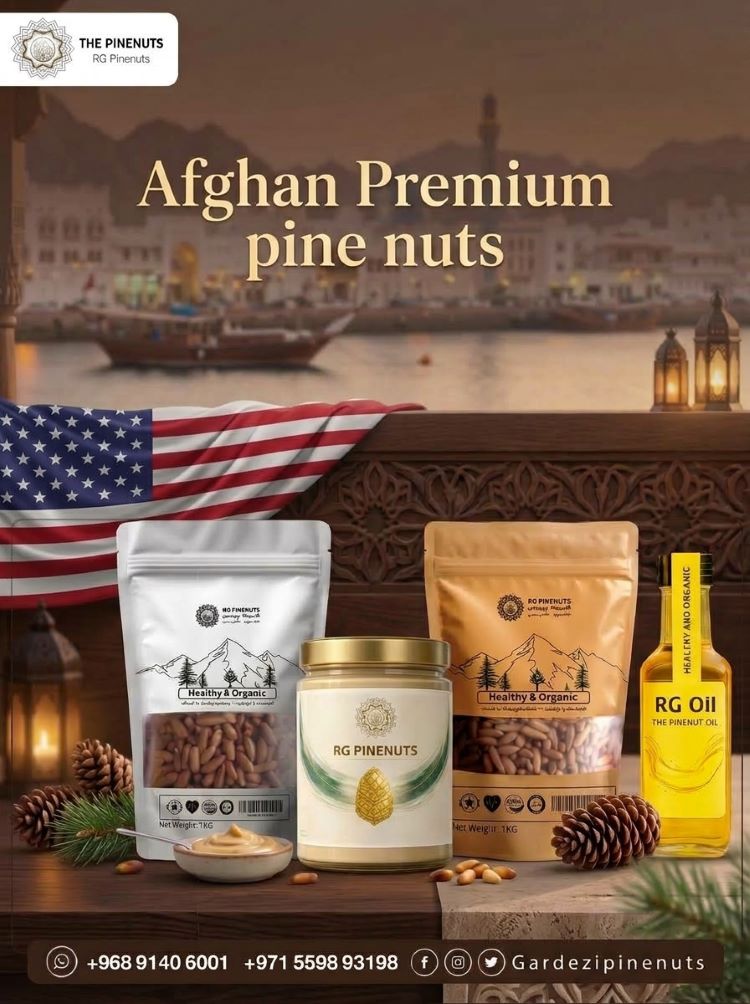
RG Pinenuts is positioned around premium Afghan pine nuts and international B2B supply.
The business was founded in Afghanistan in 2021 and focuses on high-quality pine nut products, including Golden Pine Nuts, Pine Nut Kernels, Pine Nut Oil, and Pine Nut Butter. Its stated positioning emphasizes quality, hygiene, innovation, and trust, with the tagline “RG Pinenuts — Pure Quality. Trusted Origin.”
For a U.S.-focused service page, the strongest approach is to support these positioning statements with first-party evidence such as:
This is especially important because Google encourages content demonstrating first-hand expertise and satisfying the user’s need without forcing them to search elsewhere.
Do not claim USDA Organic certification, FDA approval, HACCP certification, ISO certification, specific U.S. customers, or a specific annual processing capacity unless those claims can be documented.
A professional exporter can help U.S. buyers simplify international sourcing by coordinating:
For larger importers, consistency across multiple shipments is often more valuable than simply finding the lowest initial price.
The right supplier should be able to discuss the buyer’s target grade, quantity, packaging, destination, application, delivery requirements, and quality specifications before issuing a commercial quotation.
If you are a U.S. importer, distributor, wholesaler, restaurant group, food manufacturer, or specialty-food company, a practical sourcing process is:
Specify whether you need:
State your:
Discuss:
Request appropriate:
Work with your customs broker and relevant U.S. regulatory authorities to confirm the requirements applicable to your specific product and shipment.
Before committing to a large shipment, evaluate:
Discuss:
A trial shipment can allow the buyer to validate quality, documentation, logistics, and customer response before scaling.
Afghan pine nuts generally refer to edible pine seeds sourced from Afghanistan, particularly Chilgoza pine (Pinus gerardiana). The species is native to parts of Afghanistan and the wider Hindu Kush–Himalayan region.
Chilgoza is the common name associated with Pinus gerardiana. Its edible seeds are traditionally consumed and traded as a premium dry fruit.
Afghan pine nuts can be part of international food trade, but U.S. importers must ensure that the specific product and shipment comply with applicable FDA, USDA APHIS, CBP, labeling, and other requirements. FDA requires applicable food-import procedures including Prior Notice.
Yes. Afghan pine nuts can be sourced for wholesale and commercial applications, including foodservice, specialty retail, distribution, and food manufacturing. U.S. buyers should work with exporters/importers that can provide suitable product specifications and documentation.
Yes. Pine nut kernels are particularly suitable for bulk foodservice, manufacturing, bakery, confectionery, snack, and distribution applications.
Afghan pine nuts may be described as naturally or traditionally harvested depending on their production system, but “organic” as a regulated marketing claim should not be used without verifying the applicable certification and regulatory requirements for the destination market.
Because pine nuts are oil-rich, appropriate protection from heat, oxygen, light, moisture, and prolonged unsuitable storage conditions is important for maintaining quality.
Afghan Chilgoza pine nuts are distinguished by their species, geographic origin, elongated appearance, and characteristic rich, buttery flavor.
Potential buyers include importers, wholesalers, distributors, specialty-food companies, retailers, restaurants, hotels, bakeries, confectionery manufacturers, and food manufacturers.
Provide the desired product, quantity, packaging format, destination, quality requirements, and preferred delivery terms. A supplier can then determine the appropriate commercial offer.
The opportunity for Afghan pine nuts USA extends beyond selling a traditional Afghan product. The strongest commercial proposition combines authentic origin, professional processing, quality control, responsible sourcing, appropriate packaging, regulatory awareness, and dependable international B2B supply.
For U.S. buyers, the objective should be straightforward: receive premium Afghan pine nuts that meet clearly defined specifications and arrive in a condition suitable for the intended application.
Whether you are looking for Afghan pine nut kernels, bulk pine nuts, whole Chilgoza pine nuts, pine nut oil, or pine nut butter, supplier evaluation should begin with product specifications, quality systems, documentation, packaging, traceability, and commercial reliability.
Looking to source Afghan pine nuts for the USA? Contact RG Pinenuts to discuss product specifications, bulk requirements, packaging, and international B2B supply opportunities.