
Pine nuts vs pumpkin seeds is a useful comparison for anyone choosing nutrient-dense foods for snacking, cooking, baking, food manufacturing, or ingredient sourcing. Although both are edible seeds with healthy fats, protein, minerals, and plant compounds, they differ significantly in flavor, texture, fatty-acid profiles, culinary applications, processing characteristics, and emerging food-industry uses.
Pine nuts are prized for their delicate, buttery flavor and distinctive fatty-acid profile, including pinolenic acid. Pumpkin seeds—also called pepitas when the hull is removed—are particularly notable for their protein, magnesium, zinc, unsaturated fats, phytosterols, and expanding applications in plant-based foods.
So, which is better: pine nuts or pumpkin seeds?
There is no universal winner. The better choice depends on the intended use, nutritional priorities, flavor preferences, product formulation, and sourcing requirements.
This guide compares pine nuts and pumpkin seeds from nutritional, culinary, scientific, food-processing, sustainability, and commercial perspectives.
| Feature | Pine Nuts | Pumpkin Seeds |
|---|---|---|
| Botanical category | Edible seeds from pine species | Seeds of Cucurbita species |
| Common form | Shelled kernels | Whole seeds or hulled pepitas |
| Flavor | Mild, buttery, slightly sweet | Nutty, earthy, roasted |
| Texture | Soft, tender, creamy | Firm, crunchy |
| Protein | Moderate | Relatively high |
| Healthy fats | High | High |
| Fiber | Moderate | Higher in many preparations |
| Magnesium | Present | Particularly notable |
| Zinc | Present | Particularly notable |
| Phytosterols | Present | Rich source |
| Signature compound | Pinolenic acid | Phytosterols and diverse bioactive compounds |
| Classic culinary use | Pesto, sauces, salads, bakery | Snacks, granola, breads, salads, baking |
| Oil applications | Specialty culinary and functional oils | Culinary and specialty seed oil |
| Food-industry potential | Premium ingredient and specialty nut/seed products | Protein, flour, oil and functional-food applications |
Nutrient composition varies by species, cultivar, growing conditions, processing method, roasting, and serving size. USDA FoodData Central is a major reference for food-composition data and continues to receive updates.
Pine nuts are edible seeds harvested from certain species of pine trees. They have been consumed in many culinary traditions and are particularly valued for their delicate flavor and creamy texture.
Unlike many larger tree nuts, pine nuts are technically seeds, even though they are commonly grouped with nuts in culinary and commercial contexts.
Their most distinctive nutritional characteristic is their lipid profile. Pine nuts contain substantial amounts of unsaturated fats and are notable for pinolenic acid, a polyunsaturated fatty acid that has attracted scientific interest.
Research reviews have investigated pinolenic acid and pine nut oil for possible effects involving appetite regulation, lipid metabolism, inflammation, and energy metabolism. However, much of the mechanistic evidence remains preclinical or exploratory, so these compounds should not be treated as established medical treatments.
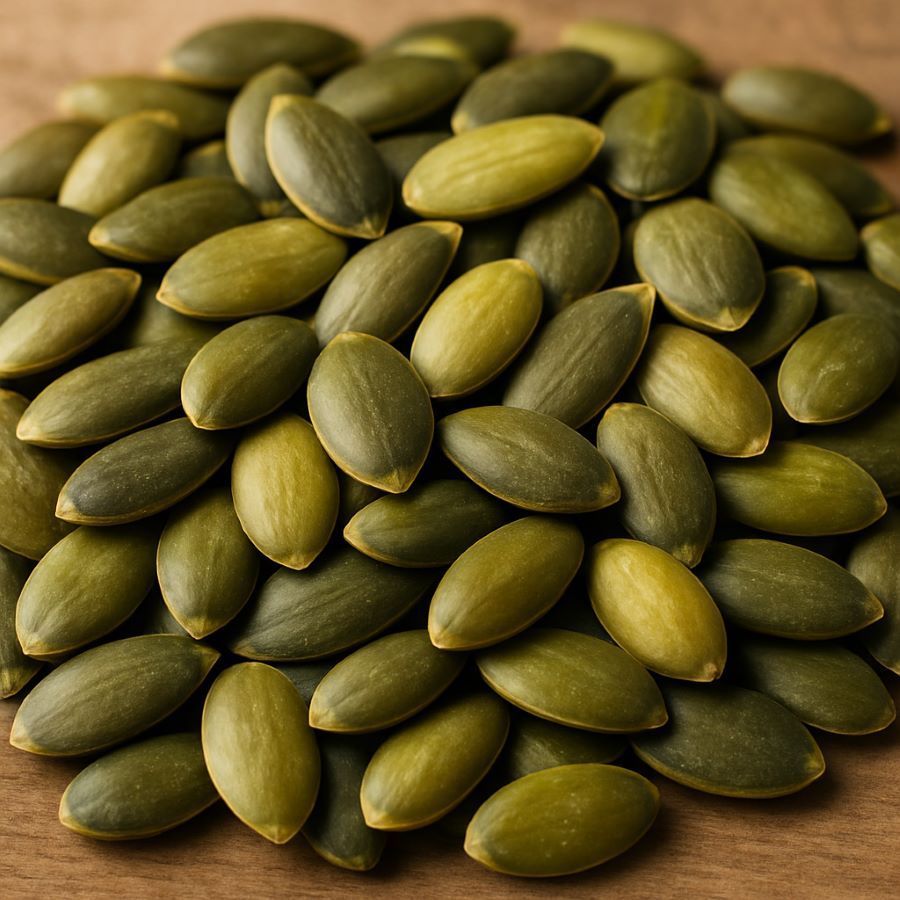
Pumpkin seeds come from pumpkins and related Cucurbita species. When the outer shell is removed, the edible green kernel is commonly called a pepita.
Pumpkin seeds are increasingly recognized as a nutrient-dense ingredient because they provide:
A recent review describes pumpkin seeds as a promising functional food because of their combination of protein, healthy lipids, fiber, minerals, phytosterols, antioxidants, and other phytochemicals.
Pumpkin seeds are also becoming increasingly important in food innovation because their proteins and oil-production by-products can be incorporated into new food formulations.
The nutritional comparison becomes more useful when we look beyond calories.
Pumpkin seeds generally have an advantage when protein density is an important consideration.
Their protein has attracted research interest as a plant-based ingredient for:
Research on pumpkin seed meal—the protein-rich material remaining after oil extraction—highlights its potential as an underutilized plant-protein resource for innovative food applications.
Pine nuts also provide protein, but their strongest nutritional and culinary identity is generally associated with their fats, flavor, and texture rather than their role as a concentrated protein ingredient.
Choose pumpkin seeds when protein content is a primary consideration.
Both foods contain substantial amounts of unsaturated fats.
Pine nuts are particularly interesting because their fatty-acid profile includes pinolenic acid, an unusual fatty acid that has been investigated in experimental research.
Reviews of pine nut oil report that pinolenic acid can represent a meaningful proportion of total fatty acids and has been studied for potential metabolic and appetite-related effects.
Pumpkin seeds also contain predominantly unsaturated fats, including polyunsaturated and monounsaturated fatty acids.
Their oil has been extensively investigated for its fatty-acid composition and phytochemical constituents, including tocopherols, carotenoids, polyphenols, phytoestrogens, and other compounds.
Both are nutrient-dense sources of unsaturated fats, but pine nuts stand out for pinolenic acid, while pumpkin seeds provide a broader combination of lipids and phytochemicals.
One common mistake in seed comparisons is assuming that every seed rich in polyunsaturated fat is automatically a major omega-3 source.
Pine nuts are not equivalent to flaxseed, chia seeds, or fatty fish as an omega-3 source.
Pumpkin seeds are also not generally considered one of the highest dietary sources of plant omega-3 alpha-linolenic acid (ALA).
Therefore, if your specific objective is to increase dietary ALA, other foods may be more concentrated sources.
This distinction matters for accurate SEO content because nutritional comparisons should not turn the presence of unsaturated fats into unsupported health claims.
Pumpkin seeds are particularly well known for their mineral content.
They provide meaningful amounts of:
A recent review of edible seeds emphasizes the broader nutritional importance of seeds as sources of minerals, proteins, unsaturated fatty acids, and other nutrients.
Pine nuts also contribute minerals and micronutrients, but pumpkin seeds are often particularly attractive when consumers are seeking a mineral-rich seed ingredient.
Pumpkin seeds are especially attractive for mineral-focused nutrition.
Another important difference is the presence of phytosterols, plant compounds structurally related to cholesterol.
Pumpkin seeds contain substantial phytosterol content. Research measuring phytosterols in commonly consumed seeds found pumpkin seed kernels to have high total sterol content.
Modern nutritional research continues to investigate phytosterols because controlled-trial evidence indicates that sufficient phytosterol intake can reduce LDL cholesterol, although the effects depend on dose, food matrix, and dietary context.
This does not mean that eating pumpkin seeds alone treats high cholesterol. Rather, pumpkin seeds can contribute phytosterols as part of an overall dietary pattern.
Both foods can fit into a heart-conscious dietary pattern because they provide unsaturated fats and other nutrients.
However, it is important to separate:
Established nutritional characteristics
from
Potential health effects being investigated by researchers.
For pumpkin seeds, the presence of unsaturated fats, phytosterols, minerals, and antioxidant compounds makes them nutritionally interesting.
For pine nuts, research on pinolenic acid and pine nut oil has explored lipid metabolism, inflammation, appetite, and metabolic pathways. Much of this research is mechanistic, animal-based, or preliminary rather than definitive clinical evidence.
Neither should be presented as a medical treatment. Both can be useful components of a balanced diet when consumed in appropriate portions.
Both foods are relatively energy-dense because they contain substantial amounts of fat.
That means portion size matters.
Pine nuts have attracted particular research interest because of pinolenic acid and appetite-related mechanisms. Some experimental research suggests that pine nut oil and pinolenic acid may influence pathways associated with appetite and energy metabolism.
Pumpkin seeds, meanwhile, combine:
This combination can make them useful as part of meals and snacks.
However, neither food should be marketed as a guaranteed weight-loss ingredient.
A better SEO and consumer-health approach is to describe their nutritional characteristics and explain how they can fit into an overall dietary pattern.
Nutrition is only part of the comparison.
Pine nuts typically have:
They are particularly effective when a recipe requires an ingredient that contributes richness without dominating other flavors.
Pumpkin seeds generally provide:
This makes them particularly effective in snack products and recipes where texture is important.
For delicate sauces and refined Mediterranean-style dishes, pine nuts can provide a subtle premium character.
For crunchy snacks, granola, breads, and roasted seed products, pumpkin seeds can be highly versatile.
Pine nuts are especially useful in:
Pine nuts are a classic pesto ingredient because their creamy texture and mild flavor blend naturally with basil, garlic, cheese, and olive oil.
Toasted pine nuts can add richness and crunch to green salads, grain bowls, roasted vegetables, and Mediterranean-style dishes.
They work particularly well with:
Pine nuts can also be incorporated into:
Their premium positioning makes them particularly attractive for specialty food products.
Pumpkin seeds have an even broader range of mainstream snack and ingredient applications.
They can be used in:
Their crunch and roasted flavor make them particularly useful when texture is an important product attribute.
The comparison becomes particularly interesting from an industrial perspective.
Food manufacturers increasingly look for ingredients that can provide multiple functions simultaneously:
Pumpkin seeds have a significant advantage in ingredient utilization because oil extraction generates protein-rich pumpkin seed meal that can potentially be transformed into value-added food ingredients. Research describes pumpkin seed protein as a promising resource for novel food applications.
Pine nuts, by contrast, are strongly positioned as a premium specialty ingredient, particularly in products where flavor, texture, appearance, and perceived quality are important.
Food technology is expanding the potential of pumpkin seeds beyond traditional snacking.
Researchers are investigating methods for extracting and modifying pumpkin seed proteins for incorporation into innovative foods.
Potential applications include:
The literature identifies pumpkin seed meal from oil production as a particularly interesting source of plant protein because it can help turn a processing by-product into a higher-value ingredient.
Pumpkin seed oil has also received extensive research attention.
Modern studies examine:
Importantly, processing methods can influence the composition and biological properties of pumpkin seed oil.
Pine nut processing is also evolving through improvements in:
For premium pine nuts, maintaining quality from harvest through processing and storage is particularly important because the high fat content makes oxidation management a critical consideration.
For exporters and food manufacturers, consistent kernel size, cleanliness, moisture management, packaging integrity, and traceability can be just as important as nutritional composition.
One of the most important developments in the seed industry is the move toward full-value utilization.
Instead of treating processing residues as waste, food researchers are investigating ways to transform them into:
Pumpkin seed processing is particularly interesting because oil extraction can leave a protein-rich meal that may be further processed into novel food ingredients.
This reflects a broader food-industry movement toward circular processing and higher resource efficiency.
Pumpkin seeds generally have the stronger position when protein is the primary objective.
Their protein-rich meal is also being investigated as an ingredient for next-generation plant-based foods.
Pine nuts still contribute protein, but they are generally valued more for their distinctive flavor, texture, fat profile, and premium culinary applications.
Both contain unsaturated fats.
However:
Pine nuts: notable for pinolenic acid and their distinctive fatty-acid profile.
Pumpkin seeds: provide unsaturated fats alongside protein, minerals, phytosterols, and other bioactive compounds.
Therefore, the answer depends on whether the objective is a particular fatty-acid profile or broader nutritional functionality.
Both work well, but they serve different purposes.
Choose pine nuts for:
Choose pumpkin seeds for:
Pumpkin seeds are especially convenient for roasted and seasoned snack products.
They can be flavored with:
Pine nuts are also excellent as snacks, but their premium price and delicate flavor often make them more suitable for specialty snacking and culinary applications.
Plant-based food innovation is creating new opportunities for both ingredients.
Pumpkin seeds have particular potential because their proteins can be extracted and incorporated into alternative food systems. Recent research specifically highlights pumpkin seed protein as a promising sustainable protein source.
Pine nuts are better positioned where manufacturers want:
Therefore, the two seeds can complement rather than simply compete with one another.
For buyers, distributors, food manufacturers, and importers, nutritional composition is only one part of the decision.
Important commercial considerations include:
Origin can affect:
Buyers should evaluate:
Both pine nuts and pumpkin seeds contain significant amounts of fat, so proper storage and packaging are important for maintaining freshness and minimizing quality deterioration.
Commercial buyers may source:
For B2B customers, consistent:
can be critical.
Afghanistan is associated with distinctive pine nut-producing regions, and Afghan pine nuts can occupy an attractive position in specialty and international markets.
For businesses sourcing Afghan pine nuts, important considerations include:
For a premium Afghan pine nut supplier, communicating these factors clearly can help differentiate the product from generic commodity listings.
RG Pinenuts, founded in 2021 in Afghanistan, specializes in supplying high-quality organic pine nuts, with products including Golden Pine Nuts, Pine Nut Kernels, Pine Nut Oil, and Pine Nut Butter.
The brand’s stated positioning emphasizes careful processing, quality, hygiene, innovation, trust, standard processing and cold storage, and export-quality Afghan products.
Price varies significantly according to:
Pine nuts are commonly positioned as a premium ingredient, while pumpkin seeds are available across a broader range of commodity and specialty applications.
For B2B purchasing, the lowest price is not necessarily the lowest total cost.
A buyer should also consider:
yield + quality + wastage + shelf life + consistency + logistics + supplier reliability.
Neither is universally healthier. Pine nuts provide a distinctive unsaturated-fat profile and pinolenic acid, while pumpkin seeds provide substantial protein, minerals, phytosterols, and other bioactive compounds. The better choice depends on the individual’s dietary needs and intended use.
Generally, yes. Pumpkin seeds are particularly useful when a food or diet requires a more protein-dense seed ingredient.
Pine nuts contain polyunsaturated fats, but they should not be considered a major source of ALA omega-3. Their better-known distinctive fatty acid is pinolenic acid.
Yes. Pumpkin seeds are recognized as a mineral-rich food and are particularly notable for magnesium.
Taste is subjective. Pine nuts are typically more delicate and buttery, while pumpkin seeds tend to have a stronger nutty and earthy flavor.
Pine nuts are the traditional choice for classic pesto because of their creamy texture and mild flavor.
Sometimes. Pumpkin seeds can substitute for pine nuts in salads, pesto variations, sauces, breads, and other recipes, but the flavor and texture will change.
Yes. Both are botanically seeds, although pine nuts are commonly categorized with nuts in culinary and commercial contexts.
Yes. Research is actively investigating pumpkin seed protein and pumpkin seed meal as sustainable ingredients for novel food applications.
The most useful way to compare these two ingredients is by their strengths.
Pumpkin seeds offer particularly interesting opportunities in protein extraction, oil production, by-product valorization, and plant-based formulations.
Pine nuts offer a distinctive combination of flavor, texture, visual appeal, and premium positioning.
Pine nuts vs pumpkin seeds is not simply a question of which food is healthier.
They are different ingredients with different nutritional and commercial strengths.
Pine nuts stand out for their delicate flavor, premium culinary applications, high unsaturated-fat content, and distinctive pinolenic acid. Pumpkin seeds stand out for their protein, minerals, phytosterols, crunch, versatility, and growing potential as a sustainable plant-protein ingredient.
Scientific research continues to expand the understanding and commercial potential of both ingredients. Recent research is particularly interesting around pumpkin seed protein, phytosterols, functional oils, and value-added processing, while pine nut research continues to explore pinolenic acid and pine nut oil.
For consumers, the best choice depends on dietary needs and culinary goals. For food manufacturers and international buyers, the decision should also consider processing, quality, supply consistency, shelf life, origin, and intended application.
Primary keyword:pine nuts vs pumpkin seeds
Secondary keywords:
Commercial keywords:
Recommended URL slug:
/pine-nuts-vs-pumpkin-seeds/
SEO title:
Pine Nuts vs Pumpkin Seeds: Nutrition, Benefits & Key Differences
Suggested meta description:
Pine nuts vs pumpkin seeds: compare nutrition, protein, healthy fats, minerals, benefits, taste, culinary uses, processing, sustainability, and sourcing.
To strengthen this page as part of a broader topical authority strategy, connect it internally with related content such as:
Use descriptive internal anchor text rather than repeatedly using the exact same keyword.
Google’s current guidance emphasizes comprehensive, original, helpful, reliable, people-first content rather than writing to an arbitrary word count or producing pages primarily to manipulate rankings. Google also recommends making authorship and expertise clear where appropriate and providing information that adds substantial value beyond simply rewriting other sources.
Structured data can help Google understand page content and may support eligible search appearances, but markup does not guarantee a particular ranking or rich result.
Important SEO note: Google does not publish a formula that guarantees position #1. The strongest approach is to build a genuinely useful resource, demonstrate expertise and sourcing, satisfy the searcher’s intent better than competing pages, maintain strong technical SEO and page experience, and continuously improve the content based on real search performance.